

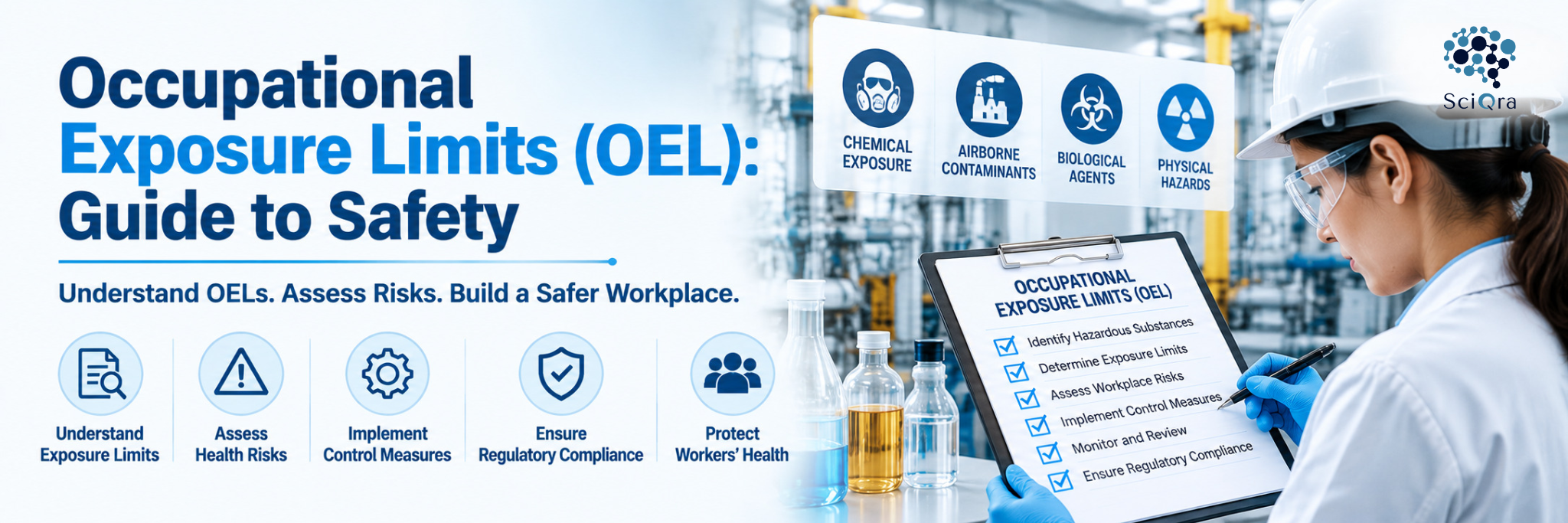
Workers in industrial environments regularly encounter airborne chemicals, vapors, gases, dusts, fumes, or aerosols as part of routine operations. Determining how much exposure to a given substance is acceptable, over what period of time, and under what conditions, is one of the central questions in occupational health and industrial hygiene.
An Occupational Exposure Limit (OEL) is one of the most important tools used to answer that question. It represents a science-based reference value that guides how much of a substance workers can be exposed to, typically expressed as an airborne concentration over a defined period. It's worth being clear from the outset that not every OEL carries the same legal weight; some are binding regulatory limits, while others are voluntary professional guidelines, and that distinction matters a great deal in practice.
Occupational Exposure Limit (OEL) — Quick Summary
An Occupational Exposure Limit (OEL) is a science-based reference value representing the airborne concentration of a substance that workers can reasonably be exposed to over a defined period, typically without causing an unacceptable risk of adverse health effects. OELs are established using toxicological data, including dose-response relationships, critical health effects, and exposure route and duration, evaluated by regulatory agencies, professional organizations, or qualified toxicologists. They matter because they give employers and industrial hygienists a scientifically grounded reference point for evaluating workplace exposure. OELs are used alongside air monitoring, hazard assessment, and the hierarchy of controls to manage occupational chemical exposure, though they don't by themselves guarantee that exposure below the limit is risk-free for every worker.
What Is an Occupational Exposure Limit (OEL)?
An Occupational Exposure Limit (OEL) is a reference concentration, typically expressed in units like mg/m³ or ppm, that represents the level of airborne exposure to a substance considered acceptable over a defined averaging period, based on available toxicological and scientific evidence. OELs are developed by regulatory bodies, professional organizations, or qualified toxicologists and are not intended to guarantee zero risk for every individual worker under every condition.
Why Are Occupational Exposure Limits Important?
OELs matter because they give employers, industrial hygienists, and safety professionals a scientifically grounded reference point for protecting worker health. Without a defined exposure limit, there's no consistent basis for deciding whether a workplace's airborne chemical levels represent a meaningful health concern or an acceptable condition.
This protection extends across both acute effects, harm that can occur from short, high-level exposures, and chronic effects that develop from repeated or prolonged exposure over months or years. A well-established OEL accounts for both possibilities where relevant, informing not just whether exposure needs to be reduced, but how urgently and through what kind of control.
OELs also directly support industrial hygiene decision-making, since they give hygienists a defined target to compare against monitoring data when evaluating whether existing controls are adequate or need improvement. That said, an OEL is most useful when it's integrated into a broader occupational health program, alongside hazard assessment, exposure monitoring, and a genuine hierarchy of controls, rather than treated as a single standalone safety number that, once satisfied, ends the conversation about workplace chemical safety.
How Are Occupational Exposure Limits Established?
OELs are established through a structured scientific process that begins with hazard identification and toxicological data collection, gathering the available evidence on a substance's potential health effects from animal studies, human data, and mechanistic research where available.
From that evidence base, scientists identify the critical health effect, the most sensitive and relevant adverse effect the limit needs to protect against, and evaluate the dose-response relationship associated with it. This typically involves selecting an appropriate point of departure, a specific dose or concentration from the available data that serves as the starting point for further calculation, such as a NOAEL or benchmark dose.
The exposure route and duration relevant to real-world occupational settings get factored in, along with a careful review of both human epidemiological evidence and animal study data where human data is limited. Adjustment or uncertainty factors are applied where appropriate, accounting for gaps like extrapolating from animal to human data or variability in sensitivity across a worker population. Occupational exposure patterns, including typical work schedules and exposure duration, inform how the final value gets expressed, and the resulting derivation undergoes scientific and regulatory review before a final exposure value is selected. It's important to understand that this exact methodology varies meaningfully among different authorities and organizations; there's no single universal formula applied identically by every body that sets exposure limits.
The Role of Toxicology in Establishing an OEL
Toxicological evidence forms the scientific foundation beneath every credible OEL, and this is exactly the kind of toxicological risk assessment work that connects laboratory and epidemiological data to a workable occupational safety value. Acute toxicity data reveals what happens after short, high-level exposure, while repeated-dose and chronic toxicity studies show how effects develop or accumulate over sustained exposure periods.
Where relevant to the substance in question, reproductive and developmental toxicity, carcinogenicity, and genotoxicity data all factor into identifying the critical effect an OEL needs to guard against. Respiratory sensitization and irritation potential matter significantly for airborne substances specifically, since these effects can occur at exposure levels well below those causing systemic toxicity. Target-organ toxicity data helps pinpoint exactly which biological system is most vulnerable to a given substance.
Human epidemiological data, where available, often carries particular weight since it reflects real occupational exposure rather than an animal model extrapolation, though robust human data isn't available for every substance. Animal studies and mechanistic data fill in gaps where human evidence is limited, and the overall dose-response relationship ties all of this together, informing where meaningful concepts like NOAEL, LOAEL, benchmark dose, point of departure, and uncertainty factors come into play. These tools are applied selectively based on the specific evidence available for a given substance, not through a single universal formula applied identically across every chemical.
Types of Occupational Exposure Limits
Several distinct exposure limit formats exist, each addressing a different aspect of workplace exposure.
A Time-Weighted Average (TWA) represents exposure averaged across a defined work period, commonly an 8-hour workday in many systems, smoothing out fluctuations in exposure over that time. A Short-Term Exposure Limit (STEL) addresses a different concern entirely, limiting exposure over a shorter window, often 15 minutes, since some health effects are driven by peak concentrations rather than average exposure across a full shift. A Ceiling Limit goes further still, representing a concentration that should never be exceeded at any point during the work period, according to the relevant standard or guideline.
A Permissible Exposure Limit (PEL) is specifically OSHA terminology in the United States, representing a legally enforceable occupational exposure limit under U.S. federal regulation. A Recommended Exposure Limit (REL) comes from NIOSH, the U.S. research and recommendation-focused agency; RELs are science-based recommendations rather than legally binding regulatory limits. A Threshold Limit Value (TLV) is ACGIH terminology, representing a professional organization's guideline based on scientific review; TLVs are widely referenced and influential but are not automatically federal regulations simply because they're published by a respected professional body.
OEL vs PEL vs REL vs TLV Comparison
Understanding how a consultant's role differs from other regulatory and quality resources helps brands figure out what kind of support actually fits their situation.
Applicable requirements ultimately depend on the specific jurisdiction, substance, workplace, and governing regulations involved. A substance might have an OSHA PEL, a NIOSH REL, and an ACGIH TLV simultaneously, each with a different numerical value and a different legal or advisory status, which makes confirming the source and applicability of any specific limit an essential step before relying on it.
Occupational Exposure Limit vs Permissible Exposure Limit
An Occupational Exposure Limit is a broad, umbrella term covering any science-based exposure reference value, regardless of which organization publishes it or what legal status it carries. A Permissible Exposure Limit is a specific type of OEL: the legally enforceable exposure limit established by OSHA under U.S. federal regulation.
In practical terms, every PEL is a type of OEL, but not every OEL is a PEL. NIOSH RELs and ACGIH TLVs are also OELs in the broad sense, but they carry advisory rather than direct regulatory status on their own, even though ACGIH TLVs, in particular, get referenced heavily across industry and sometimes get incorporated into other regulatory frameworks. Understanding which specific category a given exposure value falls into, and what legal weight that category actually carries, matters considerably more than simply knowing a number exists.
How to Interpret an OEL Value
Consider a hypothetical example: OEL-TWA: 10 mg/m³ over 8 hours. This hypothetical figure represents an airborne concentration, 10 milligrams of the substance per cubic meter of air, averaged across a standard 8-hour work shift.
The averaging period matters enormously here. A TWA smooths out fluctuation across the full shift, which means it should not automatically be interpreted as permission for unrestricted short-term peaks, since a worker could theoretically experience a brief period of much higher exposure that still averages out to an acceptable TWA across the full 8 hours. This is exactly why STEL or ceiling limits may also apply to the same substance, addressing exactly the kind of peak exposure concern a TWA alone doesn't fully capture.
Beyond the numerical value itself, hazard annotations matter significantly. A skin notation, for example, indicates that dermal absorption contributes meaningfully to a worker's total exposure, meaning airborne concentration alone doesn't tell the full story for that substance. This hypothetical example illustrates the kind of interpretation required; actual OEL values and their associated notations must always be confirmed against the authoritative source publishing them.
Occupational Exposure Limits and Workplace Air Monitoring
Industrial hygiene monitoring is how actual workplace exposure gets compared against relevant OELs in practice. Personal air sampling, where a monitoring device travels with an individual worker throughout their shift, generally provides the most representative picture of that worker's actual exposure, while area monitoring measures concentrations at a fixed location and can miss variation tied to specific tasks or movement patterns.
Direct-reading instruments offer real-time concentration data, useful for identifying acute peaks or verifying that engineering controls are functioning as intended, while a well-designed sampling strategy considers similar exposure groups, workers performing comparable tasks under comparable conditions, so that monitoring data reasonably represents the broader workforce rather than just the individuals actually wearing sampling equipment.
Task-based monitoring examines exposure tied to specific activities rather than an entire shift, which can reveal short-duration peak exposures that a full-shift TWA sample would average out and obscure. Laboratory analysis of collected samples generates the underlying data, which then gets converted into TWA calculations or compared directly against short-term limits depending on the sampling duration used. Documentation and trend analysis over time help identify whether exposure levels are stable, improving, or worsening, which matters for verifying that existing controls remain adequate as conditions change. Representative sampling design and professional interpretation of the results are both essential; monitoring data collected or interpreted poorly can be genuinely misleading regardless of how sophisticated the underlying equipment is.
How Companies Assess Occupational Chemical Exposure
A structured occupational exposure assessment generally follows a logical sequence: hazard identification establishes what substances are present and what health effects they're associated with, followed by OEL selection or derivation, identifying the relevant applicable limit or, where none exists, developing an appropriate internal reference value.
Exposure assessment estimates how workers actually encounter the substance in question, informed directly by air monitoring data collected through personal or area sampling. Risk characterization then combines the hazard and exposure information into an overall risk picture, closely related to broader chemical risk assessment practices used across regulated industries. Exposure controls get selected and implemented based on that risk characterization, followed by verification, confirming the controls actually reduce exposure as intended, and periodic reassessment, since process changes, new substances, or updated toxicological evidence can all shift a previously adequate risk picture.
What Happens When Workplace Exposure Exceeds an OEL?
When monitoring reveals exposure above a relevant OEL, the hierarchy of controls provides the standard framework for determining an appropriate response, though exact regulatory obligations vary by jurisdiction and applicable standard.
Elimination, removing the hazard entirely, sits at the top of the hierarchy as the most effective option when genuinely feasible, followed by substitution, replacing the substance with a less hazardous alternative. Engineering controls, including improved ventilation, process enclosure, or physical isolation of the hazard source, address exposure at a systemic level rather than depending on individual behavior. Administrative or work-practice controls, adjusted schedules, rotation, or revised procedures, modify how work happens around a hazard that can't be eliminated or engineered away entirely.
Personal protective equipment, including respiratory protection where appropriate, sits at the bottom of the hierarchy, protecting the individual worker directly rather than reducing hazard exposure at its source. Beyond selecting an appropriate control, additional worker training, continued monitoring, and reassessment after any control changes are typically warranted to confirm the response actually brought exposure back within an acceptable range. Exact legal obligations triggered by an exceedance depend heavily on the applicable jurisdiction, the specific standard involved, and whether the exceeded limit carries regulatory or advisory status.
OELs and Safety Data Sheets (SDS)
Occupational exposure values commonly appear in Section 8, Exposure Controls/Personal Protection, of a Safety Data Sheet, where applicable exposure limits for a substance are typically listed alongside recommended control measures.
Safety professionals reviewing this information should confirm several things before relying on it: the specific source of the listed limit, which jurisdiction it applies to, the exposure duration and averaging period it represents, the units used, any applicable hazard notation like skin absorption, how current the information actually is, and whether multiple organizations publish different values for the same substance, which happens more often than many safety teams expect. An SDS is a useful starting reference, but it is not, on its own, sufficient for a complete occupational risk assessment; it's one input among several that a thorough exposure evaluation should draw on.
What If No Occupational Exposure Limit Exists?
Many substances, particularly newer chemicals, proprietary formulations, or less commonly studied compounds, simply don't have an applicable authoritative or regulatory OEL published anywhere. This is a more common situation than many companies expect, and it doesn't mean exposure can't be responsibly managed; it means a different scientific approach is needed.
Qualified professionals addressing this gap can draw on several approaches, including occupational exposure banding, categorizing a substance into a hazard band based on available data even without a precise numerical limit, and toxicological evaluation of the substance's own available data. Read-across from structurally similar, well-characterized substances can apply where scientifically justified, alongside available health-based guidance values from other contexts, closely related to the kind of health-based exposure limit and OEL/PDE derivation work used in pharmaceutical and chemical manufacturing settings.
Internal or company-specific OEL development is another path, along with control banding approaches and conservative, precautionary risk-management strategies applied while better data is gathered. It's worth being direct here: deriving a company-specific OEL requires genuine toxicological expertise, careful evaluation of the available evidence, and defensible scientific judgment. It is not something that should be reduced to a generic online calculator or a simple rule-of-thumb applied without qualified scientific review.
Can You Calculate an Occupational Exposure Limit?
Workplace exposure calculation and scientific OEL derivation are two fundamentally different activities that are easy to conflate. Calculating a worker's actual TWA exposure from air-monitoring results is a mathematical exercise: converting sampling data into an average concentration over a defined period using established formulas.
Deriving a new, health-based OEL is a different undertaking entirely. It requires toxicological evaluation of the underlying hazard data, dose-response analysis to understand how effects change with exposure level, scientific judgment about which effects are most relevant and protective, and an appropriate methodology suited to the available evidence for that specific substance. There is no single universal formula that correctly derives an OEL for every chemical; the process depends on the nature and quality of the toxicological evidence available, which varies enormously from one substance to the next.
OEL Compliance in Chemical Manufacturing Industries
Chemical manufacturers face particular pressure to manage occupational exposure carefully, given the volume and diversity of substances often present across a single facility. This typically starts with a maintained chemical inventory and systematic hazard identification, followed by a review of applicable regulatory limits and current SDS information for every substance handled, an area closely tied to broader regulatory compliance obligations manufacturers need to satisfy.
Defining exposure scenarios and similar exposure groups helps structure a monitoring program efficiently, followed by actual air monitoring, appropriate engineering controls, and a genuine PPE program where needed. Worker training, thorough documentation, and a formal change management process, ensuring new substances or process modifications trigger a fresh exposure evaluation, round out a mature program. Periodic reassessment keeps the whole system current as conditions, substances, and available toxicological evidence evolve. It's worth being precise that "compliance" in this context always has to be evaluated against the specific regulations applicable to the jurisdiction and operation in question, not against a generic, one-size-fits-all standard.
Common Mistakes When Managing Occupational Exposure Limits
Treating all OELs as legally equivalent is one of the most consequential mistakes, since a PEL, a REL, and a TLV can carry meaningfully different legal weight even when addressing the same substance. Using outdated exposure limits, when an organization has since revised its guidance, and ignoring exposure duration when comparing monitoring data against a limit expressed for a different averaging period, both distort the resulting risk picture.
Ignoring STEL or ceiling values in favor of TWA compliance alone overlooks peak-exposure risks that a shift-average number simply doesn't capture, and ignoring skin absorption where a relevant notation applies underestimates a worker's true total exposure. Comparing values with mismatched units, without proper conversion, produces results that look meaningful but aren't actually comparable, and using area samples as a substitute for personal worker exposure data, without clear justification, can significantly misrepresent actual individual exposure.
Assuming exposure below an OEL means zero risk for every worker ignores the reality that individual sensitivity varies, and OELs are designed to protect the majority of a working population, not necessarily every individual under every circumstance. Failing to consider multiple chemicals present simultaneously, relying only on SDS information without broader scientific review, and failing to reassess exposure after a process or material change all leave genuine gaps in an otherwise reasonable exposure management program.
Best Practices for Managing Occupational Chemical Exposure Risks
Maintain an updated chemical inventory covering every substance actually present in the workplace
Identify applicable occupational exposure limits for each substance and confirm their source
Verify authoritative sources rather than relying on a single unverified reference
Review current Safety Data Sheet information, including Section 8 exposure controls
Conduct thorough workplace hazard assessments covering all relevant exposure routes
Establish appropriate exposure monitoring using representative sampling strategies
Compare measured exposure data against the relevant, currently applicable limits
Apply the hierarchy of controls, favoring elimination and engineering controls where feasible
Document all decisions, monitoring results, and control changes thoroughly
Reassess exposure whenever processes, materials, or work practices change
Review new toxicological and regulatory information periodically, since guidance evolves over time
When Does a Company Need an Occupational Toxicology or OEL Assessment?
Professional support becomes particularly valuable when no published OEL exists for a substance a company handles, or when conflicting exposure limits from different organizations create genuine uncertainty about which value should guide decision-making. Introducing a new chemical into a process, or working with proprietary substances that don't appear in standard regulatory databases, are common triggers as well.
New toxicological information becoming available that calls an existing limit into question, manufacturing process changes that alter exposure scenarios, and situations where existing OELs require careful scientific interpretation to apply correctly to a specific workplace context all warrant expert involvement. Companies needing to develop internal, health-based exposure limits for substances without an authoritative published value represent another clear case where qualified toxicological expertise is genuinely necessary rather than optional.
How an Occupational Toxicology Consultant Can Help
A qualified occupational toxicology consultant supports this work through structured toxicological literature review, hazard identification, and critical-effect identification, the same rigorous groundwork behind broader toxicology consulting services. This extends into dose-response assessment and, where appropriate, formal OEL derivation for substances lacking an authoritative published value.
Consultants can also evaluate existing published OELs for scientific currency and applicability to a specific use case, support occupational exposure banding approaches, and connect exposure findings to a broader chemical risk assessment. This often overlaps meaningfully with toxicology data gap assessment work, since a missing OEL is, functionally, a specific type of data gap requiring its own scientific resolution. Documentation of the scientific rationale behind any derived or evaluated limit, along with broader regulatory toxicology support for industrial hygiene and risk-management teams, rounds out what a consultant typically provides. No consultant can guarantee regulatory acceptance of a derived limit or guarantee specific worker safety outcomes; what professional support offers is a more scientifically defensible foundation for exposure management decisions.
Why Choose SciQra for Occupational Exposure Limit Assessment?
SciQra supports companies with scientific toxicology evaluation and evidence-based risk assessment relevant to occupational exposure limit questions, including structured literature review, dose-response evaluation, and occupational exposure assessment support tailored to a specific substance and workplace scenario.
Our approach emphasizes transparent scientific documentation and regulatory toxicology expertise, translating complex toxicological evidence into risk-based recommendations that hold up under scrutiny. SciQra positions itself as a scientific and regulatory support partner, not a guarantee of regulatory acceptance or specific safety outcomes. Need scientific support for evaluating or deriving an Occupational Exposure Limit? Consult SciQra's regulatory toxicology team for an evidence-based assessment tailored to your substance and workplace exposure scenario.
Key Takeaways
An Occupational Exposure Limit (OEL) is a science-based reference value representing acceptable airborne exposure to a substance over a defined period.
OELs exist primarily to protect worker health from both acute and chronic effects of chemical exposure.
OEL derivation relies on toxicological evidence, including dose-response assessment and identification of the critical health effect.
TWA, STEL, and ceiling limits address different aspects of exposure, from shift-average concentration to short-term peaks.
OEL, PEL, REL, and TLV are related but distinct terms with different organizational sources and legal or advisory status.
Air monitoring, through personal and area sampling, is how actual workplace exposure gets compared against relevant OELs.
The hierarchy of controls, from elimination through PPE, guides the response when exposure exceeds an applicable limit.
Many substances have no published authoritative OEL, requiring specialized approaches like exposure banding or internal derivation.
Calculating a measured TWA from monitoring data is fundamentally different from scientifically deriving a new OEL.
Deriving or evaluating an OEL requires qualified toxicological expertise, not a generic formula or calculator.
Conclusion
An Occupational Exposure Limit (OEL) is one of the foundational tools in occupational health and industrial hygiene, giving employers and safety professionals a scientifically grounded reference point for managing workplace chemical exposure. But an OEL is only as useful as the context it's applied within: understanding whether a given value is a regulatory PEL or an advisory REL or TLV, confirming its averaging period and applicable notations, and recognizing when no authoritative limit exists at all.
OELs work best as one component of a broader occupational health program, alongside hazard assessment, representative air monitoring, and a genuine hierarchy of controls, rather than as a standalone number that, once satisfied, ends the safety conversation. Because exposure limits vary by jurisdiction, substance, and organization, and because deriving a limit where none exists requires real toxicological expertise, professional scientific support is often the difference between a defensible exposure management program and one built on assumptions. If your organization needs help evaluating or deriving an Occupational Exposure Limit, SciQra team can provide an evidence-based assessment tailored to your specific substance and workplace.
Frequently Asked Questions
What is an Occupational Exposure Limit (OEL)?
An Occupational Exposure Limit is a science-based reference value representing the airborne concentration of a substance considered acceptable for worker exposure over a defined period, based on toxicological evidence. OELs are established by regulatory agencies, professional organizations, or qualified toxicologists and serve as a reference point for evaluating and managing workplace chemical exposure, though not every OEL carries the same legal status.
Why are occupational exposure limits important?
OELs give employers and safety professionals a scientifically grounded basis for protecting worker health from both acute and chronic effects of chemical exposure. They support informed decisions about exposure controls, guide air monitoring programs, and connect toxicological evidence to practical workplace safety decisions, though they work best as part of a broader occupational health program rather than a standalone safety measure.
How are occupational exposure limits established?
OELs are established through hazard identification and toxicological data collection, followed by identifying the critical health effect and evaluating the dose-response relationship. Scientists select an appropriate point of departure, apply uncertainty factors where relevant, and consider exposure route and duration before the value undergoes scientific and regulatory review. The exact methodology varies among different organizations and authorities.
What is the difference between an OEL and a PEL?
An OEL is a broad umbrella term covering any science-based occupational exposure reference value, regardless of the publishing organization. A PEL, Permissible Exposure Limit, is a specific type of OEL: the legally enforceable exposure limit established by OSHA under U.S. federal regulation. Every PEL is an OEL, but not every OEL is a PEL, since some, like NIOSH RELs or ACGIH TLVs, are advisory rather than regulatory.
What are TWA, STEL, and ceiling exposure limits?
A Time-Weighted Average (TWA) represents exposure averaged over a defined work period, commonly 8 hours. A Short-Term Exposure Limit (STEL) addresses shorter-duration peak exposures, often over 15 minutes, since some effects relate more to peak concentration than shift-average exposure. A Ceiling Limit represents a concentration that should never be exceeded at any point during the work period.
How do toxicology studies help establish occupational exposure limits?
Toxicology studies provide the evidence base for OEL derivation, including acute and chronic toxicity data, dose-response relationships, and identification of the critical health effect a limit needs to protect against. Human epidemiological data and animal studies both contribute, along with mechanistic evidence, informing concepts like NOAEL, point of departure, and appropriate uncertainty factors used in deriving a scientifically defensible limit.
How are OELs used in workplace air monitoring?
Air monitoring, through personal or area sampling, measures actual airborne concentrations of a substance in the workplace, which are then compared against the relevant OEL to assess whether exposure is within an acceptable range. Personal sampling generally provides the most representative picture of individual worker exposure, while representative sampling strategy and professional interpretation are essential for meaningful results.
What happens if employee exposure exceeds an OEL?
When exposure exceeds a relevant OEL, the hierarchy of controls guides the response, generally favoring elimination or substitution first, followed by engineering controls, administrative controls, and personal protective equipment where higher-level controls aren't fully feasible. Additional monitoring and reassessment typically follow any control change, and exact regulatory obligations depend on the applicable jurisdiction and whether the exceeded limit is regulatory or advisory.
What should a company do if no OEL exists for a chemical?
When no authoritative OEL exists, qualified professionals can use approaches like occupational exposure banding, toxicological evaluation of available data, scientifically justified read-across from similar substances, or internal OEL development. These approaches require genuine toxicological expertise and shouldn't be reduced to a generic calculator; conservative risk-management measures are often appropriate while better data is developed.
Can a company develop its own occupational exposure limit?
Yes, companies can develop internal, health-based exposure limits when no authoritative published value exists, but this requires qualified toxicological expertise, careful evaluation of available evidence, and defensible scientific judgment about the critical effect and appropriate uncertainty factors. It is fundamentally different from simply calculating a measured exposure value from monitoring data.