

Introduction
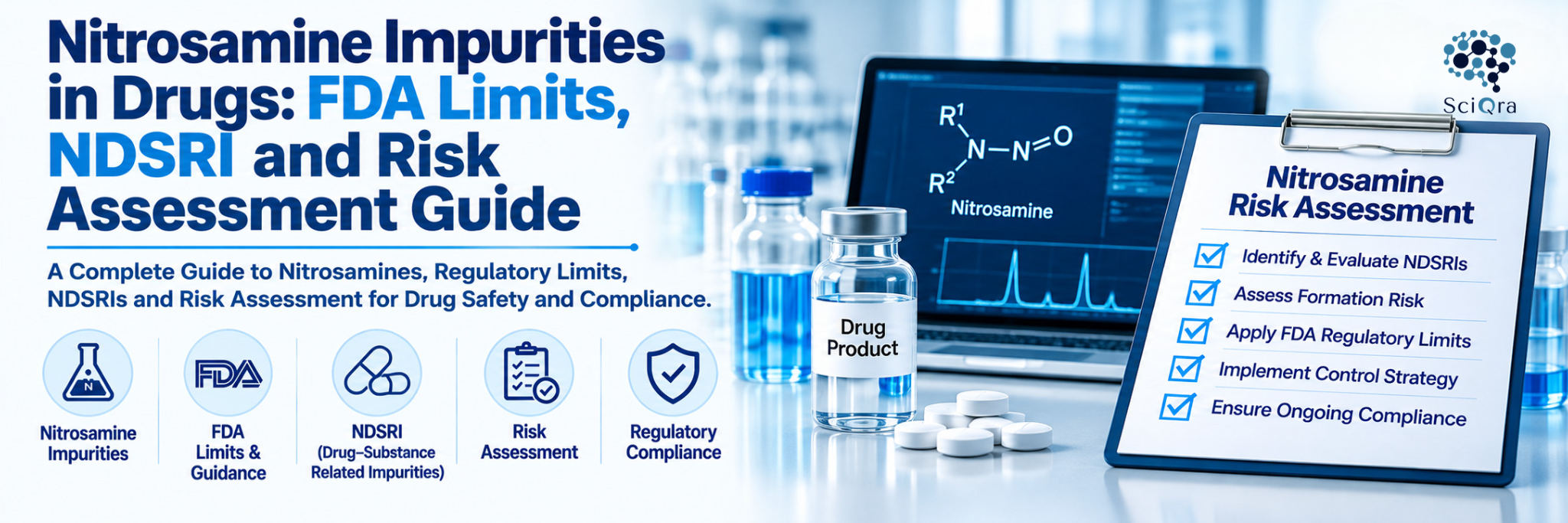
Nitrosamine impurities are a patient-safety and product-quality issue because several N-nitrosamines are potent mutagenic carcinogens in animal studies. Manufacturers of active pharmaceutical ingredients (APIs) and finished drug products therefore have to assess whether these impurities could form, whether they are present, and whether any exposure is acceptable. This work sits within wider pharmaceutical toxicological risk assessment and impurity control.
The topic has two layers. Small-molecule nitrosamines such as N-Nitrosodimethylamine(NDMA) and N-Nitrosodiethylamine (NDEA) were the first to draw attention. Nitrosamine drug substance-related impurities (NDSRIs), which share structural features with the API itself, follow and are often harder to assess. Acceptable intake (AI) limits can be compound-specific, and Food and Drug Administration (FDA) and European Medicines Agency (EMA) recommendations change over time, so published values should always be checked against current sources. Detecting a nitrosamine does not by itself describe patient risk; compound identity, exposure, and toxicological evidence decide that.
Overview Summary
Nitrosamine impurities are N-nitroso compounds that can arise in drug substances and products, and some are potent mutagenic carcinogens in animal studies. NDSRIs are nitrosamines structurally related to the API. Regulators recommend an AI limit, an amount per day considered to carry a negligible lifetime cancer risk, which is compound-specific. Manufacturers assess formation risk, test where warranted, evaluate toxicology, compare exposure with the applicable AI, and control or mitigate. FDA and EMA publish related but not identical guidance, which should be verified for each product.
What Are Nitrosamine Impurities?
Nitrosamine impurities are chemical impurities containing the N-nitroso functional group that may occur in pharmaceutical ingredients or products. Some raise carcinogenicity concerns, but significance depends on the specific compound, patient exposure, available toxicological evidence, and the applicable regulatory recommendation. Not all nitrosamines have the same potency or risk.
Quick Answer: How Are Nitrosamine Impurities Assessed?
Manufacturers identify potential sources and formation pathways, assess risk in the API and finished product, and decide whether confirmatory testing is warranted. Relevant impurities are identified and quantified, and compound-specific toxicological evidence is evaluated to establish or confirm the applicable acceptable intake. Estimated patient exposure is compared with that limit. Controls are then implemented and documented, effectiveness is verified, and the assessment is revisited when processes, materials, or regulatory guidance change.
What Are Nitrosamine Impurities in Pharmaceutical Drugs?
N-nitrosamines contain a nitroso group (N=O) bonded to an amine nitrogen. Many require metabolic activation, mainly by cytochrome P450 enzymes, to form reactive species that can damage Deoxyribonucleic Acid (DNA). This is why some nitrosamines appear carcinogenic in rodent studies and are treated as probable human carcinogens by regulators, while others are far less potent or lack evidence of carcinogenicity.
They can form when a nitrosating agent, such as nitrite under acidic conditions, reacts with a secondary or tertiary amine. Sources can include reagents, solvents, starting materials, recycled materials, process conditions, excipients, and sometimes degradation during storage. A nitrosamine can also be introduced through a contaminated raw material rather than formed in the process.
It is important to separate presence from risk. The presence of a nitrosamine in a batch does not, on its own, show that patients face an unacceptable risk, and not every API or drug product contains nitrosamines. Compound identity and exposure level determine the conclusion.
Why Are Nitrosamine Impurities a Concern for Drug Manufacturers?
The concern is potential carcinogenicity from long-term exposure, which makes patient safety and drug product quality central. Because products can be taken for years, regulators use conservative lifetime assumptions when setting limits.
For manufacturers, the practical consequences include product-specific regulatory obligations, process and supply-chain risk, and the need for root cause investigations and control strategies. Risk depends on the specific compound, its potency, patient exposure, and the applicable assessment framework, not merely on a positive detection.
What Are NDSRIs?
Nitrosamine drug substance-related impurities (NDSRIs) are nitrosamines that share structural features with the API, for example, when the API contains a secondary or tertiary amine that can be nitrosated. They can form during manufacture or storage and may also arise from degradation.
Their assessment can be more complex than for some small-molecule nitrosamines. NDSRIs are often unique to one API, so compound-specific toxicological data may not exist. This makes potency assessment, analytical characterization, and acceptable intake determination more dependent on structure-activity relationship (SAR) analysis, read-across, and regulatory frameworks. Documentation must explain the formation pathway, the evidence used, and the uncertainty.
NDSRIs vs Small-Molecule Nitrosamines
Structural relationship to the API: NDSRIs are structurally related to the API; small-molecule nitrosamines such as NDMA and NDEA are simple, widely studied compounds that are not API-specific.
Compound-specific data: small-molecule nitrosamines often have carcinogenicity data. NDSRIs frequently do not.
Assessment approaches: NDSRIs rely more on SAR, read-across, potency categorization, and in some cases additional testing.
Importance of SAR and read-across: higher for NDSRIs, where analogue data is the main evidence.
Acceptable intake: set compound by compound. Not all NDSRIs are more potent than other nitrosamines; potency depends on structure and metabolism.
FDA Nitrosamine Guidance and Acceptable Intake Limits
FDA's guidance Control of Nitrosamine Impurities in Human Drugs (Revision 2, September 2024) recommends steps for API and drug product manufacturers to detect and prevent unacceptable levels of nitrosamine impurities. It describes root causes, risk assessment, confirmatory testing, and reporting of changes. A related guidance addresses recommended acceptable intake limits for NDSRIs, and FDA maintains a Center for Drug Evaluation and Research (CDER) webpage with AI values that it updates.
FDA guidance represents the agency's current thinking and is not binding in itself, but it describes expectations that manufacturers need to address. According to the guidance, the three-step process for small-molecule nitrosamines was to be completed by October 1, 2023, and FDA recommended confirmatory testing and submission of changes for products that may contain NDSRIs by August 1, 2025. A June 2025 update indicated that applicants unable to finish by then could submit a progress update. Check FDA's current page for the latest timelines, since they may have changed.
What Are Nitrosamine Acceptable Intake Limits?
An acceptable intake (AI) is the daily amount of a nitrosamine, expressed as mass per day (typically ng/day), that regulators consider to carry a negligible lifetime cancer risk. It is derived using conservative assumptions for lifetime exposure and is not a prediction of an individual's outcome.
Three related quantities should not be confused: the AI itself (ng/day), a concentration limit in a drug product (for example, ppm or µg/g), and a patient's actual exposure, which depends on the drug's maximum daily dose and the impurity level found. The concentration limit is derived from the AI and the dose; it is not an independent value.
How Are Acceptable Intake Limits Established?
The approach depends on the compound, the available evidence, and the framework applied. Where robust carcinogenicity data exist, a compound-specific AI can be derived from dose-response evidence. Where data are limited, regulators use approaches such as the Carcinogenic Potency Categorization Approach (CPCA), which assigns a potency category from structural features and corresponding AI, or read-across from a well-characterized surrogate. FDA's webpage lists AI values determined by predicted potency categorization, by compound-specific or surrogate data, and interim limits for certain products.
Computational toxicology, SAR, and expert review also contribute, and scientific uncertainty should be documented. An AI should not be selected solely from structural similarity or from an unverified table found online; use the current regulator-published value or a justified, documented derivation.
How Is an Acceptable Intake Limit Converted to a Product Concentration?
The general conversion divides the AI by the maximum daily dose of the drug product.
Impurity concentration limit (ng/g) = Acceptable intake (ng/day) ÷ Maximum daily dose (g/day)
If the dose is in milligrams: Impurity concentration limit (ng/mg) = Acceptable intake (ng/day) ÷ Maximum daily dose (mg/day). A result in ng/mg is numerically equivalent to µg/g, or ppm by mass.
Hypothetical example (not a real AI for any compound): Assume an AI of 100 ng/day and a maximum daily dose of 500 mg/day. The limit is 100 ng/day ÷ 500 mg/day = 0.2 ng/mg, which equals 0.2 µg/g or 0.2 ppm. Check in grams: 500 mg = 0.5 g, so 100 ng/day ÷ 0.5 g/day = 200 ng/g = 0.2 µg/g.
This is a conversion step only. It does not establish the appropriate AI. Use the currently applicable, compound-specific AI from the relevant regulator, and follow that regulator's calculation conventions, including any recommendations for products containing more than one nitrosamine.
NDSRI Risk Assessment and Potency Categorization
NDSRI risk assessment starts with chemical structure and API-related structural features, then considers likely metabolic activation, any relevant carcinogenicity evidence, SAR analysis, read-across justification, and computational toxicology. These feed into potency categorization and the compound-specific AI determination, and uncertainty is documented throughout.
CPCA is one potency categorization approach in regulatory use. Because categorization depends on structural features that affect metabolic activation, expert review is needed to confirm that a structure fits the approach. Where it does not, or where better data exist, alternative evidence and regulator engagement may be required.
Structure-Activity Relationship and Read-Across
Evidence from structurally related compounds with robust carcinogenicity data can inform an NDSRI assessment. The limits are important: structural similarity alone is not conclusive, differences in reactivity or metabolic activation can change potency, and a documented scientific rationale with supporting data is necessary. Our work on read-across and in silico approaches in related impurity contexts reflects the same principles.
Computational Toxicology
In silico tools can predict mutagenicity or support SAR and read-across, particularly when data are sparse. Predictions are inputs to expert judgment, not proof. A negative prediction does not demonstrate safety and a positive one does not establish carcinogenicity. Results should be reviewed, with the model, applicability domain, and limits documented.
How to Conduct a Nitrosamine Impurity Risk Assessment
The sequence below is a practical approach. Follow current regulatory guidance for product-specific requirements.
1. Understand the drug substance and drug product
Objective: Define scope.
Review API structure, formulation, dosage form, manufacturing process, and maximum daily dose (MDD).
2. Identify potential nitrosamine sources
Objective: Find where impurities could originate.
Assess raw materials, reagents, solvents, starting materials, recycled solvents, process water, manufacturing equipment, excipients, packaging interactions, and storage conditions.
3. Evaluate formation pathways
Objective: Understand plausible chemical reactions.
Identify specific conditions during synthesis, formulation, or storage where nitrosating agents and susceptible amines could react.
4. Assess NDSRI potential
Objective: Check API-related structural risk.
Evaluate whether the API structure, synthetic intermediates, or degradants can form a drug-substance-related nitrosamine under process conditions.
5. Determine analytical testing needs
Objective: Decide on testing strategy.
Base testing requirements on the documented risk assessment, regulatory guidance, product-specific specifications, and available chemical evidence.
6. Evaluate toxicological risk
Objective: Understand compound potency.
Review available compound-specific carcinogenicity data, Structure-Activity Relationships (SAR), read-across analogues, or regulatory potency categories.
7. Estimate patient exposure
Objective: Quantify daily intake.
Calculate patient exposure using measured analytical impurity concentrations, the maximum daily dose, and consistent unit conversions (ppm/ng/mg).
8. Compare exposure with the applicable AI
Objective: Draw a safety conclusion.
Compare calculated exposure against the current compound-specific Acceptable Intake (AI) limit, documenting the regulatory source, rationale, and underlying assumptions.
9. Develop a control and mitigation strategy
Objective: Prevent or reduce impurity levels.
Prioritize chemical prevention, process design changes, supplier controls, formulation adjustments (e.g., adding antioxidants), and validated monitoring.
10. Document and reassess
Objective: Maintain lifecycle control.
Formally record the assessment findings, conclusions, identified uncertainties, and specific triggers for periodic reassessment (e.g., supplier or process changes).
Nitrosamine Impurity Testing and Analytical Methods
Analytical testing supports the risk assessment by confirming whether a nitrosamine is present and at what level. Common techniques include Liquid Chromatography-Tandem Mass Spectrometry (LC-MS/MS) and Gas Chromatography-Mass Spectrometry (GC-MS), and high-resolution mass spectrometry for identification, using targeted methods and, in some cases, screening approaches. Reference standards, where available, are needed for quantification.
Method selection depends on the compound's properties, the drug product matrix, the expected concentration, and the required performance. Considerations include specificity, sensitivity, and quantification limits, recovery, matrix effects, and confirmatory testing. No single method is suitable for all nitrosamines or all matrices, and low limits are often needed because AI-derived concentration limits can be very small.
Analytical Method Validation
Validation typically addresses specificity, accuracy, precision, working range or linearity where applicable, detection and quantification capability, and robustness. Use current regulatory and compendial expectations rather than a single universal checklist, and confirm the method is fit for the specific drug product matrix.
When Is Nitrosamine Testing Required?
It depends on the product, the documented risk assessment, relevant guidance, and the regulatory context. Testing is generally expected where the assessment identifies a plausible risk, and regulators have recommended confirmatory testing for products with identified risk. It is not automatically required for every product in the same way, so determine need from the applicable guidance and your risk assessment.
Nitrosamine Impurity Mitigation and Control Strategies
Mitigation should start with prevention. Options include removing or replacing problematic raw materials, controlling nitrosating agents and susceptible amines, optimizing process conditions such as pH and temperature, and reviewing solvent recovery and reuse. Stronger supplier qualification, evaluating excipient contributions (for example nitrite content), and checking formulation compatibility and packaging risks where relevant also help.
Validated analytical controls and monitoring of process and product changes complete the strategy. Any change must be scientifically justified and consider product quality, process validation, stability, and regulatory change-control obligations. A change that reduces one risk but introduces another is not a mitigation.
Pharmaceutical Nitrosamine Investigation and Root Cause Analysis
A structured investigation defines the problem, reviews batch and analytical data, maps the process, and assesses raw materials and suppliers. It then considers manufacturing history and potential formation mechanisms, confirms hypotheses in the laboratory, and determines the root cause.
Corrective and preventive actions (CAPA), effectiveness verification, regulatory impact assessment, and ongoing monitoring follow. Detecting an impurity does not automatically identify its source; it may come from an upstream material, the process, a degradation pathway, or cross-contamination, and each requires evidence.
FDA vs EMA Nitrosamine Requirements
FDA and EMA both recommend a risk-based approach covering assessment, confirmatory testing, and control, but their documents and procedures differ. FDA issues guidance and maintains a webpage with recommended AI values, while the EU framework includes European Medicines Agency Q&A documents and procedures run with national authorities. Recommendations are related but not always identical, so verify product-specific obligations in current official guidance.
Nitrosamine Impurity Compliance Checklist for Pharmaceutical Manufacturers
Review the API and finished product
Identify potential nitrosamine formation pathways
Assess raw materials, reagents, solvents, and suppliers
Evaluate NDSRI formation potential
Document the risk assessment methodology
Determine whether analytical testing is warranted
Select suitable analytical methods
Evaluate toxicological evidence
Establish or verify the applicable AI
Calculate potential patient exposure
Compare exposure with the applicable limit
Implement proportionate mitigation measures
Document root cause and CAPA when needed
Review regulatory reporting or communication obligations
Monitor changes in process, formulation, and guidance
Retain traceable scientific and quality documentation
This checklist supports planning and does not replace applicable regulatory requirements.
How SciQra Can Support Nitrosamine Risk Assessment
SciQra provides toxicology and regulatory support for pharmaceutical impurities. Its impurity qualification services cover toxicological risk assessment of potentially genotoxic impurities, including threshold of toxicological concern approaches. Nitrosamine and NDSRI questions often draw on the same skills, including toxicological evaluation, SAR and read-across, scientific literature review, and acceptable intake assessment support.
SciQra can help with impurity risk documentation, regulatory toxicology consulting, and interpretation of analytical data, as well as health-based limits through its health-based exposure limit derivation. A toxicology data gap analysis can show where compound-specific data are missing, and regulatory compliance support can help align documentation with current expectations. For the wider context, see SciQra's toxicological risk assessment services and toxicology consulting services.
SciQra acts as a scientific and regulatory support partner and does not guarantee regulatory outcomes. Need support evaluating nitrosamine impurities or NDSRI-related toxicological risks? Contact SciQra to discuss your pharmaceutical impurity assessment and regulatory documentation needs.
Key Takeaways
Nitrosamine impurities are N-nitroso compounds, some of which are potent mutagenic carcinogens, but potency varies widely.
Risk is compound-specific: identity, potency, and exposure matter more than detection alone.
NDSRIs are nitrosamines structurally related to the API and often lack compound-specific data.
An acceptable intake (AI, ng/day) is not the same as a product concentration limit or actual patient exposure.
Toxicological assessment establishes or confirms the applicable AI using the evidence available.
SAR, read-across, and computational toxicology support assessment, but need expert review and documented rationale.
Analytical methods must suit the compound and matrix and be validated; no single method fits all.
Root cause investigation requires evidence; detection does not identify the source.
Mitigation should prioritize prevention and consider quality, validation, stability, and change control.
FDA and EMA guidance are related but not identical; verify current compound-specific values and timelines and reassess when they change.
Conclusion
Nitrosamine impurities require a documented, compound-specific approach. Manufacturers assess where nitrosamines could form, test where the assessment warrants it, evaluate toxicological evidence, and compare patient exposure with the applicable acceptable intake. NDSRIs add challenges because data are often limited and the assessment relies on SAR, read-across, and expert judgment.
Root cause analysis and proportionate mitigation then keep the impurity under control, supported by traceable documentation. Because FDA and EMA recommendations and AI values change, reassessment is part of the job. If you want a second opinion on your approach, SciQra's team can discuss your assessment and documentation needs.
Frequently Asked Questions
What are nitrosamine impurities in pharmaceutical drugs?
They are impurities containing an N-nitroso group that can occur in APIs or finished products. Some are potent mutagenic carcinogens in animal studies, which is why they are assessed. Their significance depends on the compound, patient exposure, toxicological evidence, and regulatory recommendations, so their presence alone does not define risk.
What are NDSRIs, and how do they differ from other nitrosamines?
NDSRIs are nitrosamine drug substance-related impurities, structurally related to the API itself. Unlike small-molecule nitrosamines such as NDMA, they are often unique to one drug and may lack compound-specific data, so assessment relies more on SAR, read-across, and potency categorization. Potency varies; they are not all more potent.
What are the FDA limits for nitrosamine impurities in medicines?
There is no single universal limit. FDA recommends compound-specific acceptable intake values, published on its CDER webpage and based on potency categorization, compound-specific or surrogate data, or interim limits. Identify the compound and check the current FDA value before applying a limit.
How are acceptable intake limits established for nitrosamine impurities?
They depend on the available evidence. With robust carcinogenicity data, a compound-specific AI can be derived from dose-response information. Otherwise, regulators use approaches such as the CPCA or read-across from a surrogate, with SAR and computational toxicology informing expert review. Uncertainty and assumptions should be documented.
How do manufacturers conduct an NDSRI risk assessment?
They review the API structure and process, identify nitrosating agents and amine sources, and evaluate plausible formation pathways. Testing needs are decided from the documented risk, and toxicological evidence is reviewed to determine the applicable AI. Exposure is then compared with the limit and the rationale is documented.
What analytical methods are used to detect nitrosamine impurities?
LC-MS/MS and GC-MS are widely used, and high-resolution mass spectrometry supports identification. Method choice depends on the compound, drug product matrix, expected concentration, and required sensitivity. Methods need validation for specificity, accuracy, precision, and quantification limits, and no single method suits all nitrosamines.
Is nitrosamine testing required for every pharmaceutical product?
Not in the same way for every product. Requirements depend on the documented risk assessment, relevant guidance, and the product's regulatory context. Testing is generally expected where a plausible risk is identified. Check current FDA, EMA, or other applicable guidance for product-specific obligations.
How can pharmaceutical manufacturers prevent or mitigate nitrosamine contamination?
By preventing formation and introduction: replacing problematic raw materials, controlling nitrosating agents and amines, adjusting process conditions, qualifying suppliers, and reviewing solvents and excipients. Validated monitoring supports control. Changes should consider quality, stability, validation, and regulatory change-control requirements.
How do FDA and EMA nitrosamine guidance documents differ?
Both recommend risk-based assessment, testing where warranted, and control, but they are separate documents with their own procedures, timelines, and sometimes differing AI values. FDA relies on guidance and a CDER webpage, while the EU uses EMA Q&A documents and national procedures. Verify current versions for each market.
What is the role of toxicological assessment in nitrosamine impurity regulatory compliance?
It establishes whether an exposure is acceptable. Toxicologists evaluate compound-specific data, SAR, read-across, and computational evidence to establish or confirm an AI, then compare it with estimated patient exposure. They also document uncertainty, supporting the control strategy and regulatory submissions.