

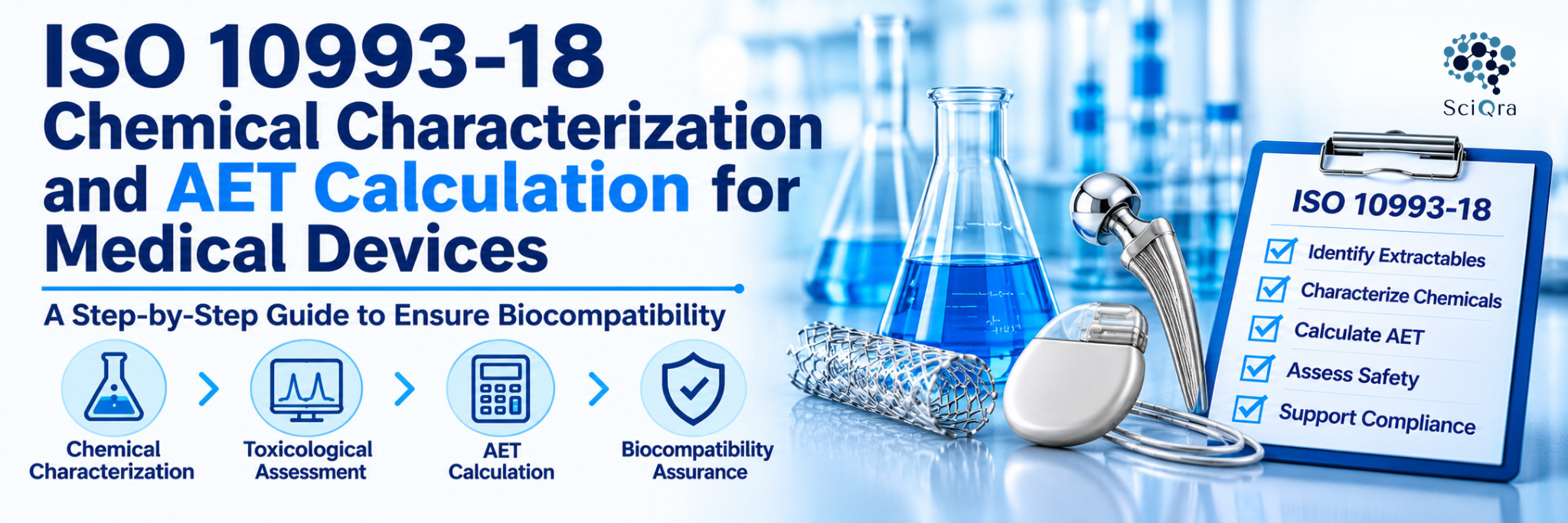
ISO 10993-18 is an international standard that provides a framework for the chemical characterization of medical device materials, and it is a key input to biological evaluation. Before a toxicologist can judge whether a device is biologically safe, the manufacturer needs to know what can come out of it. Chemical characterization helps identify and, where appropriate, quantifies chemical constituents that may be released from a medical device under relevant extraction or use conditions. The Analytical Evaluation Threshold (AET) sets the level above which they are identified, quantified, and reported for toxicological assessment. The results then feed toxicological risk assessment.
The standard does not by itself, establish the biological safety of medical devices.. It describes how to generate chemical evidence in a defensible way, and the AET is an analytical threshold, not a toxicological safety limit. This article walks from the purpose of the standard through extractables and leachables, the AET equation, a clearly hypothetical worked example, interpretation of results, and report preparation.
Scope and limitations: this is an educational overview. It does not reproduce the standard, and the equations and factors described should be checked against the published ISO 10993-18:2020, its Amendment 1:2022, and other relevant regulatory guidances.
What Is ISO 10993-18 and Why Is It Important for Medical Devices?
ISO 10993-18 describes a framework for identifying and quantifying the chemical constituents of a medical device and the substances that can be released from it. It sits within the ISO 10993 series on biological evaluation and supports a risk-based assessment, not a fixed test list.
The current edition is ISO 10993-18:2020, with Amendment 1:2022 on determining the uncertainty factor. Confirm the edition and any later changes that apply in your market. Relevant substances can come from the materials themselves, from additives and processing aids, from manufacturing and sterilization residues, from degradation, or from contamination. The device's materials, intended use, contact type and duration, and patient exposure all shape how much characterization is appropriate.
Identifying a chemical is not the same as assessing its risk. Chemical characterization answers what is present and how much; toxicological risk assessment decides whether the resulting exposure is acceptable.
What Is Chemical Characterization of Medical Devices?
Chemical characterization is the systematic investigation of a device's chemical composition and releasable constituents. In practice it combines material and formulation information, device construction and manufacturing history, known and potential impurities, extractables and leachables, and degradation-related compounds where relevant.
Sample selection and device configuration matter, because the tested sample must represent the finished, sterilized device. A documented chemical characterization plan states the objectives, the rationale for the approach, and how results will be used. The depth of the strategy depends on the materials, the nature, duration, and route of contact, the intended clinical use, and the overall risk assessment.
Extractables and Leachables Testing Under ISO 10993-18
Extractables and leachables testing is an important approach to chemical characterization. Planning them requires choices about extraction media, conditions, and analytical methods, which is why many manufacturers involve specialists in medical device extractables and leachables testing.
What Are Extractables?
Extractables are substances that can be released from a device or material when it is extracted under defined, often aggressive, conditions. The extraction is designed to reveal the chemical profile that might be released.
Design choices include the extraction medium (polar, semi-polar, and non-polar solvents are commonly considered), temperature, duration, surface area or mass, and the device-to-extraction-medium ratio. Exaggerated conditions can be scientifically justified when they aim to exhaust releasable material, but they change the profile that is observed, so the rationale must be documented.
What Are Leachables?
Leachables are substances actually released from a device under clinically relevant or simulated-use conditions. They are a subset of what could be extracted, and their levels depend on how the device is used.
Extractables are not the same as patient exposure. Exaggerated extraction can release far more than occurs in use, so extractables results should not automatically be treated as exposure. They can, however, inform the design of leachables investigations and the toxicological assessment, for example by showing which compounds to look for and which assumptions are conservative.
Selecting Analytical Methods
No single technique detects every constituent. Method selection should reflect the expected chemical space, extraction conditions, instrument capability, and study objectives.
GC-MS (gas chromatography-mass spectrometry): suited to volatile and semi-volatile organic compounds.
LC-MS (liquid chromatography-mass spectrometry): suited to non-volatile and thermally labile organic compounds.
ICP-MS (inductively coupled plasma mass spectrometry): used for elemental analysis, for example metals.
Complementary techniques: used where justified by the chemical profile, such as other detectors or spectroscopy for specific compound classes.
Each method has blind spots, including compounds that do not ionize, that degrade in the instrument, or that are poorly retained. Using orthogonal methods and documenting their limitations improves coverage.
What Is the Analytical Evaluation Threshold (AET)?
The Analytical Evaluation Threshold (AET) is a threshold above which an analyst identifies, quantifies, and reports extractables or leachables for toxicological assessment. Below it, a detected substance is considered unlikely to need individual evaluation, provided the method is adequate.
It is derived from a dose-based toxicological threshold, but it is not itself a toxicological safety limit. Its purpose is to set the sensitivity the analytical method needs, and to decide which signals are carried forward. The AET is not a universal fixed concentration: it depends on the exposure scenario, the extraction and sample preparation, and the analytical uncertainty. Per the standard, it applies to organic extractables and leachables, and it is not applied to metals because no equivalent dose-based threshold exists for them. A value below the AET is not proof of safety.
How to Calculate the Analytical Evaluation Threshold Under ISO 10993-18
ISO 10993-18:2020 Annex E describes the AET calculation, and Amendment 1:2022 addresses the uncertainty factor. In the commonly cited form, the AET in µg/mL of extract is:
AET (µg/mL) = [ DBT × A ÷ (B × C × D) ] ÷ UF
This is the general concept as described in the literature on the standard. Verify the exact equation, the definitions, and how factors are applied against the standard itself, since the choice of normalization (per device, per extract volume, per patient) must follow your study design.
Step 1: Define the Device and Exposure Scenario
Establish the device's intended use, patient-contact category, contact duration, relevant configuration, and how many devices or units a patient is exposed to per day. Define the intended patient population and extraction and sample-preparation strategy. Do not assume that every device has the same exposure scenario; a single-use catheter and a long-term implant differ.
Step 2: Establish the Relevant Toxicological Evaluation Basis
The AET needs a dose-based threshold, which depends on the toxicological evaluation approach, the contact duration, and the applicable standard or guidance. ISO 10993-18 links this to the TTC approach described in ISO/TS 21726. Select it according to those documents and the patient exposure. No single value suits every compound or device, so do not borrow a number from a different context.
Step 3: Account for the Extraction and Sample Preparation
The AET equation depends on the extraction volume (B) and the number of devices extracted (A), and on any dilution or concentration (D). Recovery and method limitations also matter. The calculation must match the actual laboratory workflow and the units of the analytical results: if the extract is concentrated before analysis, the threshold in the analyzed solution changes.
Step 4: Account for Analytical Method Response
Screening methods do not respond equally to all compounds. Response factors vary between compounds, so a quantity estimated against a surrogate standard may be under- or over-estimated. The uncertainty factor corrects for this by lowering the AET where response variation is high, so that compounds are not missed.
Step 5: Convert the Threshold to the Appropriate Reporting Basis
Depending on the method, the threshold can be expressed as a concentration in the extract (µg/mL), an amount per device (µg/device), or an estimated patient exposure. Extraction volume, dilution, and device normalization govern the conversions. When the AET is expressed per device, A and B cancel out, leaving a function of DBT, C, D, and UF. Do not mix units or apply a factor without recording its origin.
Step 6: Document the AET Calculation and Assumptions
The report should state the calculation approach and its source, the exposure scenario and assumptions, extraction and sample-preparation details, the analytical methods and response considerations, units and conversions, the UF and its rationale, the basis for the DBT, and how the threshold was applied to the findings.
Worked AET Calculation Example
This is a hypothetical, simplified teaching example. The values are illustrative assumptions, not prescribed defaults or universal ISO constants, and the DBT is not a recommendation for any real device.
Assumed parameters:
DBT = 10 µg/day (hypothetical)
A = 2 devices extracted
B = 100 mL of extract
C = 1 device per day
D = 1 (no dilution or concentration)
RSD of response factors = 0.5 (assumed), so UF = 1 ÷ (1 − 0.5) = 2
Step 1, Calculate AET: DBT × A ÷ (B × C × D) = 10 µg/day × 2 devices ÷ (100 mL × 1 device/day × 1) = 0.2 µg/mL.
Step 2, apply the uncertainty factor: AET = 0.2 µg/mL ÷ 2 = 0.1 µg/mL.
Step 3, check on a per-device basis: 0.1 µg/mL × 100 mL ÷ 2 devices = 5 µg/device. This equals DBT ÷ C ÷ UF = 10 ÷ 1 ÷ 2 = 5 µg/device, which confirms the units.
Effect of concentration: if the extract is concentrated ten-fold before analysis (D = 0.1), the threshold in the analyzed solution becomes 0.2 ÷ 0.1 = 2 µg/mL, and ÷ UF gives 1 µg/mL. The per-device threshold is unchanged at 5 µg/device.
Interpretation: the analytical method must reliably detect and quantify compounds at or below 0.1 µg/mL in this extract. A compound found above the AET is identified and quantified and carried into toxicological assessment. A signal below the AET is not individually reported, subject to the method being adequate.
Several factors could materially change the result: a different DBT from a different contact duration or population, a different number of devices per day or per extraction, extraction volume, dilution, and the UF. Results below the AET do not automatically establish safety, and results above it do not mean the device is unsafe. Interpretation depends on the chemical identity, exposure, toxicological evidence, and risk assessment.
How to Interpret Analytical Results Above and Below the AET
Compounds above the AET are identified and quantified as far as the method allows, then assessed toxicologically. Tentatively identified compounds need a confidence level, and unidentified features may need further work, for example additional spectra or alternative techniques, particularly if they approach or exceed the AET.
Signals below the AET are generally not individually evaluated, but the conclusion depends on the method being fit for purpose. Method detection and quantification limits should be below the AET, compounds with uncertain response factors can be under-estimated, and false negatives are possible for compounds the method cannot detect. Further identification, quantification, or toxicological evaluation can be needed when the analytical blind spots, the chemistry, or the exposure suggest a concern. A result below the AET should never be ignored automatically; the strategy must be scientifically justified and consistent with the method and the risk assessment.
Relationship Between ISO 10993-18 and ISO 10993-17
The two standards are complementary. ISO 10993-18 supplies the chemical characterization methodology and the analytical evidence. ISO 10993-17 covers toxicological risk assessment of device constituents, and the latest edition (2023) should be checked for your use. Identified and quantified constituents feed exposure estimation and toxicological assessment, which together decide whether exposure is acceptable. For a broader walk-through, see our article on toxicological risk assessment of medical devices under ISO 10993. Identification alone does not establish biological safety, and a full biological evaluation may need evidence beyond chemistry and toxicology.
Common Mistakes in ISO 10993-18 AET Calculation
Treating the AET as a universal fixed concentration. Calculate it for each exposure scenario and study design.
Using the wrong extraction volume or device normalization. Match the equation to the actual extraction.
Ignoring dilution or concentration during sample preparation. Include the D factor.
Applying unverified response factors. Establish the UF from data and document it.
Confusing extractables results with patient exposure. Distinguish extractables from leachables and justify the exposure.
Failing to document assumptions and units. Record every input and conversion.
Assuming results below the AET indicate safety. The AET is an analytical threshold, not proof.
Assuming one analytical method detects every compound. Use complementary methods and state limits.
Ignoring unidentified peaks or analytical limitations. Evaluate them against the AET and the risk.
Using outdated or unverified standard requirements. Check the current edition and amendment.
ISO 10993-18 Chemical Characterization Report Preparation
This is a practical reporting checklist, not a claim that every item is mandatory in every case. Depending on the study and requirements, a report may include:
Device identification, description, intended use, and contact scenario
Material composition and manufacturing information, where available
Study objectives and the risk-based rationale
Sample selection, preparation, extraction conditions, and rationale
Analytical methods, validation or qualification, and limitations
Data processing, compound identification, and quantification
AET methodology, assumptions, units, and application
Identified compounds, unidentified signals, and relevant findings
Exposure estimates and links to toxicological assessment, where applicable
Deviations, uncertainty, limitations, conclusions, and recommendations
ISO 10993-18 Compliance Checklist for Medical Device Manufacturers
Device and material information compiled
Intended use and exposure scenario documented
Chemical characterization strategy justified
Extraction conditions scientifically justified
Analytical methods selected for relevant chemical classes
Method capabilities and limitations documented
AET methodology and assumptions verified
Units and conversion factors checked
Results evaluated against the appropriate threshold
Unidentified or uncertain findings assessed
Toxicological risk assessment needs identified
Report and supporting records reviewed
This checklist is a planning aid. It does not replace reviewing the applicable standard and the device-specific requirements.
How SciQra Supports Medical Device Chemical Characterization
Planning the study well is often where manufacturers need help: justifying extraction conditions, selecting methods for the expected chemistry, documenting the AET assumptions, and interpreting what was found. SciQra's extractables and leachables services are designed to support that evidence-based approach to biological evaluation, and its medical device toxicology and regulatory support covers the wider context.
Because chemical data only become meaningful when assessed, SciQra connects them to toxicological risk assessment, and its approach to read-across and extractables and leachables risk assessment is described in a related article. A data gap analysis can show where information is missing, regulatory compliance support helps align documentation, and further information is on SciQra's toxicology consulting services page.
SciQra acts as a scientific and regulatory support partner and does not guarantee regulatory outcomes. If you are planning a chemical characterization study or reviewing an AET approach, contact SciQra to discuss your medical device chemical characterization needs.
Key Takeaways
ISO 10993-18 provides the framework for chemical characterization of medical device materials within biological evaluation.
Chemical characterization identifies and quantifies what a device contains or can release; it does not by itself establish safety.
Extractables are released under laboratory extraction conditions; leachables are released under clinically relevant or simulated use.
Extractables data should not automatically be treated as patient exposure.
The AET is an analytical threshold derived from a dose-based threshold, not a universal fixed concentration or a toxicological acceptance limit.
The commonly cited equation is AET = [DBT × A ÷ (B × C × D)] ÷ UF; verify it against the standard.
The uncertainty factor corrects for response variation and should be established from data and documented.
No single analytical method detects every compound; method choice and limits must be justified.
ISO 10993-17 toxicological risk assessment interprets the chemical findings, and a full evaluation may need additional evidence.
Traceable documentation of assumptions, units, and rationale makes the assessment defensible.
Conclusion
A risk-based approach to ISO 10993-18 starts with understanding the device and its exposure, then plans extraction and analysis to answer specific questions. The AET gives that plan a quantitative anchor, as long as its inputs, the dose-based threshold, extraction terms, dilution, and uncertainty factor, are justified and recorded.
Results then move to toxicological assessment under ISO 10993-17 within the wider biological evaluation. Because the details depend on the standard's current edition and on your device, careful documentation and expert review matter. If you want support designing or interpreting a study, SciQra's extractables and leachables services team can discuss your requirements.
Frequently Asked Questions
What is ISO 10993-18?
ISO 10993-18 is the international standard for chemical characterization of medical device materials within biological evaluation. It describes how to identify and quantify chemical constituents and releasable substances, including extractables and leachables. The current edition is ISO 10993-18:2020 with Amendment 1:2022, and it supports, but does not replace, toxicological assessment.
What is the Analytical Evaluation Threshold (AET)?
The AET is the threshold above which extractables or leachables are identified, quantified, and reported for toxicological assessment. It is derived from a dose-based threshold and adjusted for exposure, extraction, and analytical uncertainty. It is an analytical tool, not a toxicological safety limit, and it applies to organic substances.
How is AET calculated under ISO 10993-18?
It is commonly expressed as AET (µg/mL) = [DBT × A ÷ (B × C × D)] ÷ UF, where DBT is the dose-based threshold, A the devices extracted, B the extract volume, C the devices per day, D the dilution or concentration factor, and UF the uncertainty factor. Verify the equation and factors against the standard.
Is AET a fixed concentration for all medical devices?
No. The AET depends on the exposure scenario, the dose-based threshold chosen, the extraction volume and number of devices, sample preparation, and the uncertainty factor. Different devices, extraction designs, and analytical methods give different values, so it must be calculated and documented for each study.
What is the difference between extractables and leachables?
Extractables are substances that can be released from a device under laboratory extraction conditions, often exaggerated. Leachables are substances actually released under clinically relevant or simulated-use conditions. Extractables indicate what could be released, but they do not automatically represent patient exposure, and they help plan leachables studies.
Which analytical techniques are used for medical device chemical characterization?
Common techniques include GC-MS for volatile and semi-volatile compounds, LC-MS for non-volatile and thermally labile compounds, and ICP-MS for elements. Complementary techniques are used where justified. No single method detects every constituent, so selection depends on the expected chemistry, extraction conditions, and study objectives.
What happens when an analytical result exceeds the AET?
The compound is identified and quantified as far as the method allows and carried into toxicological risk assessment. Exceeding the AET does not mean the device is unsafe. The conclusion depends on the compound's identity, estimated exposure, toxicological data, and the overall risk assessment.
Can a result below the AET be considered safe?
Not automatically. The AET is an analytical threshold, not proof of safety. A result below it generally needs no individual evaluation if the method is adequate, but analytical blind spots, response factor uncertainty, and unidentified signals can matter. The conclusion must be scientifically justified within the risk assessment.
How does ISO 10993-18 differ from ISO 10993-17?
ISO 10993-18 covers chemical characterization, meaning identifying and quantifying constituents and releasable substances. ISO 10993-17 covers toxicological risk assessment of those constituents, using exposure estimation and toxicological data to judge whether exposure is acceptable. They complement each other, and check the current edition of each.
What information should an ISO 10993-18 chemical characterization report contain?
Typically the device description and intended use, materials, study objectives, sample selection, extraction conditions, analytical methods and limitations, identification and quantification results, AET methodology and assumptions, exposure estimates where applicable, unidentified findings, and conclusions. Contents depend on the study and requirements, not every item is mandatory in every case.