

Introduction
Impurities that can damage DNA matter in pharmaceuticals because even very small daily exposures, taken over many years, could add to cancer risk. ICH M7 is the international guideline that gives manufacturers a structured way to assess and control these DNA-reactive (mutagenic) impurities. It combines hazard identification, exposure assessment, and a risk-based control strategy, supported by sound genotoxic impurity assessment.
A central tool is the Threshold of Toxicological Concern (TTC), a default exposure level considered to carry a negligible cancer risk when impurity-specific carcinogenicity data are lacking. The TTC is not a universal limit for every impurity. It applies only within the ICH M7 framework, and compound-specific data can justify a different intake. This guide walks through the process step by step, including how to convert an acceptable intake into a product concentration limit.
Quick Summary
ICH M7 addresses DNA-reactive (mutagenic) impurities in pharmaceuticals to limit potential carcinogenic risk. Impurities are assessed using existing data, computational (Q)SAR predictions, and, where needed, bacterial mutagenicity testing, then placed in one of five classes. For many mutagenic impurities without carcinogenicity data, a Threshold of Toxicological Concern based acceptable intake applies, with limits that depend on treatment duration. The acceptable intake (µg/day) is converted into a concentration limit using the daily dose. Findings are documented in a control strategy, though compound-specific limits may apply instead.
What Is ICH M7?
ICH M7 is an international guideline on assessing and controlling DNA-reactive (mutagenic) impurities in pharmaceuticals to limit potential carcinogenic risk. Its framework covers hazard identification, risk assessment, and control strategies, and it does not prescribe the same testing or control for every impurity.
Quick Answer: How Does the TTC Approach Work Under ICH M7?
Identify and characterize the impurity, then assess mutagenic potential from existing data, in silico predictions, and bacterial mutagenicity results where needed. Classify the impurity under the guideline. If a TTC-based approach is appropriate, determine the acceptable intake for the treatment duration, convert it to a concentration limit using the daily dose, and set a documented control strategy. Impurities with carcinogenicity data, or in the cohort of concern, may need compound-specific limits instead.
What Is ICH M7 and Why Does It Matter?
ICH M7 limits potential carcinogenic risk from mutagenic impurities that arise from synthesis, degradation, or storage. Because a mutagenic impurity may act at very low doses, general impurity thresholds from ICH Q3A and Q3B are not appropriate for it. The guideline therefore ties acceptable levels to hazard (is it mutagenic?) and exposure (how much, for how long?) and expects the control to be scientifically justified.
It matters in development and in regulatory submissions: an assessment of potential impurities is normally part of the quality documentation for new drug substances and products, and for changes that could introduce new impurities. ICH M7 does not apply to every product type. It excludes categories such as biologicals, peptides, oligonucleotides, and certain others, and it is not intended for drug substances and products for advanced cancer indications. Check the scope text before applying it.
What Does ICH M7(R2) Cover?
ICH M7(R2) is the current consolidated version. It reached Step 4 and was adopted by ICH on 3 April 2023, adding compound-specific acceptable intakes for additional mutagenic impurities in its addendum and minor text updates to the R1 version. The guideline covers impurity assessment, classification, acceptable limits, and control options. ICH guidelines are not binding law; regulators such as FDA and EMA implement them on their own timelines and, in places, with their own Q&A documents, so confirm the applicable version and implementation in your market.
What Is the Difference Between Genotoxicity and Mutagenicity?
Genotoxicity is the broader term, covering any damage to genetic material, including chromosomal damage and DNA strand breaks. Mutagenicity refers to permanent changes in DNA sequence. ICH M7 focuses on mutagenic, DNA-reactive impurities because they are linked to carcinogenic risk at low doses. Genotoxic effects with a threshold mechanism, such as some aneugens, are not treated interchangeably with DNA-reactive mutagens.
What Is the Threshold of Toxicological Concern (TTC)?
The Threshold of Toxicological Concern is a risk assessment concept that derives a low exposure level considered to pose negligible risk for chemicals lacking adequate compound-specific toxicity data, within the limits of the framework applied. It lets assessors set a provisional limit without carcinogenicity studies for each impurity.
Under ICH M7 this concept is turned into an acceptable intake, which is why it is useful for many DNA-reactive impurities that are found at trace levels. It is only appropriate where the impurity is in scope and not excluded. Where carcinogenicity or potency data exist, a compound-specific approach may support a different, higher or lower, acceptable intake.
How Does TTC Apply Under ICH M7?
It helps to separate three ideas. The generic TTC concept comes from toxicological risk assessment across many chemicals. The ICH M7 default is a specific acceptable intake derived for mutagenic impurities: 1.5 µg/day for lifetime exposure, corresponding to a theoretical excess lifetime cancer risk of about 1 in 100,000. Compound-specific acceptable intakes are set from carcinogenicity data, as in the ICH M7(R2) addendum.
Do not carry over a TTC figure from a different context, such as non-mutagenic substances or food chemicals, into an ICH M7 assessment. Use the value and conditions from the guideline itself, and check them against the current official text before publication. N-nitroso compounds, aflatoxin-like compounds, and alkyl-azoxy compounds belong to a cohort of concern for which the default TTC is not appropriate and compound-specific assessment is needed, so nitrosamine-specific guidance should be consulted separately.
ICH M7 Classification of Mutagenic Impurities
ICH M7 sorts impurities into five classes based on the evidence of mutagenicity and carcinogenicity. Classification should follow the guideline's criteria and the quality of the data, not an informal judgment.
Class 1: known mutagenic carcinogens. Evidence from carcinogenicity studies; control is at or below a compound-specific acceptable intake.
Class 2: known mutagens, for example bacterial mutagenicity positive, with unknown carcinogenic potential. Control uses TTC-based acceptable intakes.
Class 3: alerting structure, unrelated to the structure of the drug substance, with no mutagenicity data. Either control at the TTC-based level or generate bacterial mutagenicity data; a negative result supports Class 5 and a positive one Class 2.
Class 4: alerting structure that is the same as in the drug substance or in related compounds that have tested non-mutagenic. Treated as a non-mutagenic impurity.
Class 5: no structural alerts, or sufficient data to show lack of mutagenicity or carcinogenicity. Treated as a non-mutagenic impurity under ICH Q3A/B.
Classes 1 to 3 involve a known or potential mutagenicity concern; Classes 4 and 5 do not, based on the evidence available. Expert review and computational predictions support the assignment, particularly for Class 3, 4, and 5.
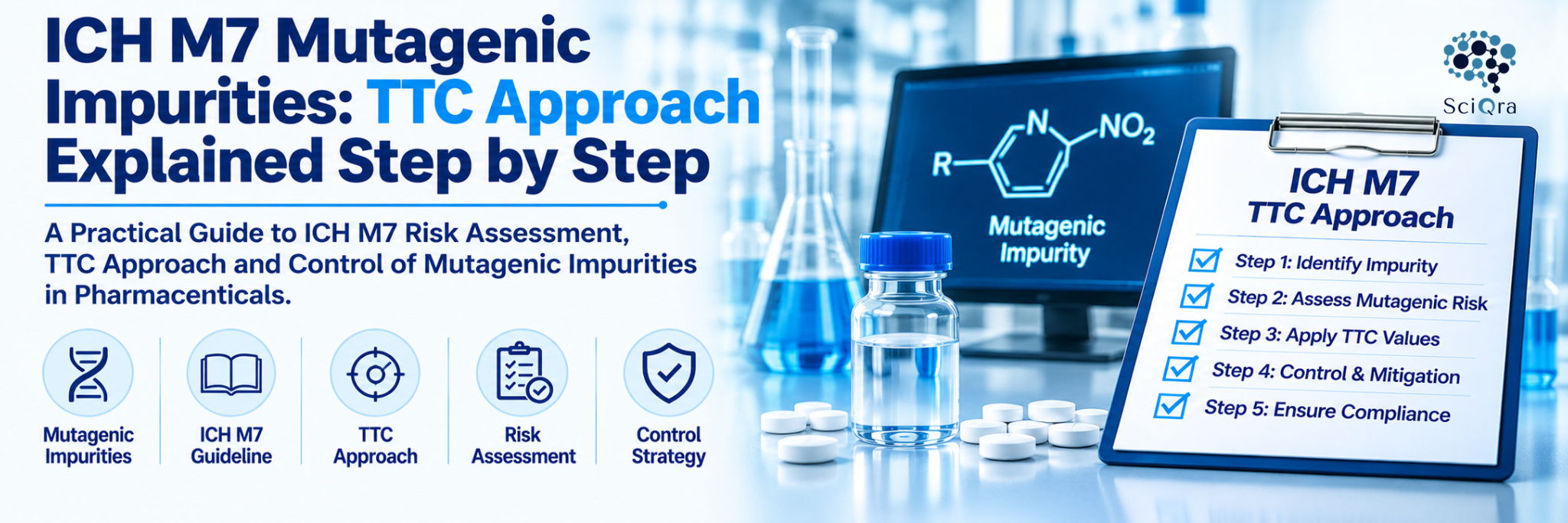
Step-by-Step TTC-Based Mutagenic Impurity Assessment
The workflow below is practical. Steps and evidence depend on the impurity, and ICH M7 should be consulted for details.
Identify the impurity. Objective: define what could be present. Consider starting materials, reagents, intermediates, by-products, degradation, and process conditions that could introduce reactive functionality. Evidence: structure, process knowledge, and analytical data. Output: a list of potential and actual impurities.
Gather existing information. Objective: use what is known. Review chemical identity, mutagenicity and toxicology data, literature, regulatory assessments, and data for structurally related compounds where justified. Evidence quality and relevance matter. Output: a data summary.
Perform a (Q)SAR assessment. Objective: predict mutagenic potential. Use one expert rule-based and one statistical-based system, as ICH M7 recommends, with expert review. A structural alert is not proof of mutagenicity, a negative prediction must be interpreted within the model's applicability domain, and conflicting predictions need expert judgment. Output: documented predictions and a conclusion.
Review or generate bacterial mutagenicity data. Objective: confirm or refute the alert. The bacterial reverse mutation (Ames) assay is the standard test. Existing data may be sufficient, and testing is considered where an alert is unresolved and the impurity is isolable. Study quality affects interpretation, and equivocal results may need further evaluation. A new Ames test is not required for every impurity. Output: data or justification.
Assign the ICH M7 class. Objective: summarize the evidence. Apply the class criteria and record the rationale. Classification determines whether further data, a control strategy, or a different acceptable intake approach is appropriate.
Determine the applicable acceptable intake. Objective: select the limit. Consider class, mutagenicity and carcinogenicity data, the guideline, treatment duration, and any exceptions. Distinguish TTC-based values from compound-specific limits. Output: acceptable intake in µg/day with rationale.
Assess treatment duration. Objective: apply less-than-lifetime logic where justified. ICH M7 Table 2 gives individual-impurity limits by duration; see the next section. Use a duration adjustment only where it is justified by the guideline and the product's actual use.
Calculate the concentration limit. Objective: translate intake to a specification-ready number. Divide the acceptable intake by the maximum daily dose using consistent units (see the calculation below).
Establish the control strategy. Objective: show the impurity is controlled to the limit. Use process understanding, purge and clearance, supplier and in-process controls, specifications, and analytical monitoring. Keep it proportionate to risk and supported by data.
Document the assessment. Objective: make it reviewable. Include impurity identity and source, structures, literature, prediction results, mutagenicity data, classification rationale, acceptable intake rationale, calculations, control strategy, assumptions and uncertainties, and review and change-control triggers.
How to Calculate TTC-Based Acceptable Intake Limits
An acceptable intake is a mass per day (µg/day). A concentration limit is a mass fraction, such as µg/g, or ppm by mass, in the drug substance or product. They are not the same, and the conversion needs the daily dose.
Impurity concentration limit (µg/g) = Acceptable intake (µg/day) ÷ Maximum daily drug substance dose (g/day)
If the dose is in mg/day, a result in µg/mg is obtained, and multiplying by 1,000 mg/g converts it to µg/g. Equivalently, divide the intake in µg/day by the dose in mg/day and multiply by 1,000.
Hypothetical example (illustrative only): Assume a Class 2 impurity, lifetime treatment, and a TTC-based acceptable intake of 1.5 µg/day. The maximum daily dose is 500 mg/day = 0.5 g/day. Limit = 1.5 µg/day ÷ 0.5 g/day = 3 µg/g (3 ppm). In mg: 1.5 µg/day ÷ 500 mg/day = 0.003 µg/mg, and 0.003 µg/mg × 1,000 mg/g = 3 µg/g.
Duration matters. ICH M7 Table 2 lists acceptable intakes for an individual impurity of 1.5 µg/day for more than 10 years to lifetime, 10 µg/day for more than 1 to 10 years, 20 µg/day for more than 1 to 12 months, and 120 µg/day for up to 1 month. Table 3 gives higher total daily intakes when several impurities are present. These come from the guideline's less-than-lifetime approach, which spreads a cumulative lifetime dose of 1.5 µg/day over 25,550 days (70 years) across the treatment period. Verify the values in the current official text before using them.
The calculation converts a chosen intake into a concentration. It does not decide which acceptable intake is toxicologically appropriate, and it should follow the relevant regulator's conventions for the product.
TTC vs Compound-Specific Acceptable Intake Limits
TTC-based approach: generally relevant for Class 2 and Class 3 impurities with no impurity-specific carcinogenicity data, applying the guideline's default intake and duration provisions.
Compound-specific approach: appropriate where carcinogenicity data or potency information exist, as for Class 1 impurities and the compounds in the ICH M7(R2) addendum, or when a cohort-of-concern substance is involved.
Why potency matters: highly potent carcinogens can warrant limits well below the default, while compounds of low potency may justify a higher, scientifically supported limit.
Framework adherence: both approaches must follow the ICH M7 methodology. A generic TTC value should not replace a compound-specific limit, and an unsupported compound-specific value should not replace the default.
Deriving a compound-specific acceptable intake or permitted exposure draws on similar skills to health-based exposure limit derivation.
Role of the Ames Test and Computational Toxicology
Computational prediction and laboratory testing complement each other. Predictions screen impurities quickly, and bacterial testing resolves unresolved alerts.
Ames Test for Mutagenic Impurities
The bacterial reverse mutation assay detects point mutations in specially designed bacterial strains, with and without metabolic activation. Under ICH M7 a positive result generally moves an impurity into Class 2, while a negative result in a well-conducted study supports Class 5 for a Class 3 impurity. Limitations include bacterial metabolism that differs from humans, insoluble or unstable test articles, and false results from cytotoxicity. Study reliability should be reviewed before relying on the outcome, and testing is considered when existing evidence is insufficient.
SAR and Computational Predictions
ICH M7 recommends two complementary (Q)SAR methodologies, one expert rule-based and one statistical-based, with expert review of the results. Alerts must be interpreted in context: conflicting predictions, compounds outside the applicability domain, and limited training data all add uncertainty. Documenting the reasoning, and using read-across from related compounds where justified, are part of good practice; related approaches are discussed in SciQra's article on read-across and in silico assessment. A prediction is evidence, not proof.
ICH M7 Control Strategies for Mutagenic Impurities
Control is about demonstrating that patients are exposed below the acceptable intake. ICH M7 describes four options: a specification limit in the drug substance (Option 1), a limit upstream in a raw material, intermediate, or in-process control with justification (Option 2), an upstream limit above the acceptable level supported by an understanding of fate and purge (Option 3), and reliance on process understanding and purge factors without routine testing (Option 4).
Practical measures include preventing formation, modifying process conditions when justified, controlling starting materials and reagents, strengthening supplier qualification, and monitoring analytically where appropriate. Purge factors and control assumptions need scientific evidence, such as chemistry-based predictions or experimental data. Not every impurity needs routine finished-product testing, and the strategy should be reassessed when manufacturing conditions change.
Regulatory Compliance and Pharmaceutical Documentation
ICH M7 supports development and regulatory submissions through documented impurity assessments, control strategy justification, and answers to regulatory questions. Maintaining the assessment through change management and lifecycle monitoring keeps it current. ICH guidelines are not binding local law, so the way they are implemented, and any additional expectations, vary by jurisdiction. This sits within wider pharmaceutical regulatory compliance planning, and the principles also inform pharmaceutical toxicological risk assessment more broadly.
ICH M7 vs Other Genotoxic Impurity Assessment Approaches
ICH M7 addresses DNA-reactive mutagenic impurities specifically. Other genotoxic concerns, such as clastogens acting through thresholded mechanisms, may need compound-specific toxicological assessment instead. The TTC concept also appears outside ICH M7, but with different numerical values and purposes.
Other frameworks apply to different impurity types, including ICH Q3A and Q3B for ordinary impurities and nitrosamine-specific recommendations from regulators. Do not assume that every potentially genotoxic impurity follows the same pathway; check scope and consider broader chemical risk assessment when starting materials and reagents are the source.
Common Mistakes in TTC-Based Impurity Assessment
Applying a generic TTC value without checking ICH M7 applicability is the most serious error; confirm scope, cohort-of-concern status, and the guideline's own numbers. Treating all genotoxic impurities as identical blurs the difference between DNA-reactive mutagens and other mechanisms.
Ignoring treatment duration can make limits unnecessarily tight or, if misapplied, too loose; apply Table 2 only when it matches actual use. Mixing units, for example µg/day with mg/day without conversion, produces results out by factors of 1,000. Treating a structural alert as conclusive, or a negative prediction as proof of safety, overstates what the model shows.
Overlooking existing compound-specific data, assuming every impurity needs a new Ames test, and confusing acceptable intake with concentration limits are common. So is relying on unsupported purge assumptions and failing to document classification rationale and uncertainty. A short worked example in the file, plus peer review of assumptions, prevents most of these problems.
ICH M7 Compliance Checklist for Pharmaceutical Manufacturers
Identify and characterize the impurity
Document its potential source and formation pathway
Review existing mutagenicity and toxicological evidence
Conduct appropriate SAR and computational assessments
Evaluate available bacterial mutagenicity data
Assign the appropriate ICH M7 impurity class
Determine the applicable acceptable intake
Consider treatment duration and daily dose
Calculate the relevant concentration limit using consistent units
Evaluate purge and process-control evidence
Define the impurity control strategy
Document the scientific rationale and uncertainty
Verify applicable jurisdictional regulatory requirements
Reassess when relevant process or product changes occur
This checklist supports planning and does not replace the guideline or applicable regulatory requirements.
How SciQra Can Support Mutagenic Impurity Assessment
SciQra provides toxicology and regulatory support for pharmaceutical impurities. Its impurity qualification services address toxicological assessment of potentially genotoxic impurities, including threshold of toxicological concern approaches. Related support can include ICH M7 assessment documentation, SAR and read-across assessment, scientific literature review, interpretation of computational predictions, and acceptable intake assessment support.
SciQra can also help with impurity control strategy documentation and regulatory toxicology consulting, through its toxicological risk assessment and toxicology consulting services. A toxicology data gap analysis can show where mutagenicity or carcinogenicity data are missing. SciQra acts as a scientific and regulatory support partner and does not guarantee regulatory outcomes. Need support with ICH M7 mutagenic impurity assessment or TTC-based risk evaluation? Contact SciQra to discuss your pharmaceutical toxicology and impurity control documentation needs.
Key Takeaways
ICH M7 provides a risk-based framework for assessing and controlling DNA-reactive mutagenic impurities to limit potential carcinogenic risk.
Mutagenic impurities can damage DNA at low doses, so ordinary ICH Q3A/B thresholds do not apply.
The TTC gives a default acceptable intake for certain impurities lacking carcinogenicity data, but it is not a universal limit and has exclusions such as the cohort of concern.
Classification into five classes, based on mutagenicity and carcinogenicity evidence, guides further assessment and control.
Two complementary (Q)SAR methodologies plus expert review support classification; an alert is not proof and a negative is not absolute.
The Ames test is used when existing data are insufficient and is not required for every impurity.
The acceptable intake depends on class, evidence, and applicable provisions, and compound-specific limits can replace the default.
Treatment duration can raise acceptable daily intake under the less-than-lifetime approach, but only when justified.
Convert intake (µg/day) to concentration (µg/g) using the daily dose and consistent units, then document the control strategy.
ICH guidelines are implemented locally, so verify jurisdictional requirements and reassess the assessment when processes change.
Conclusion
ICH M7 gives manufacturers a clear, risk-based route from impurity identification to control. Classification based on mutagenicity and carcinogenicity evidence, supported by computational predictions and, where needed, Ames data, determines whether a TTC-based acceptable intake or a compound-specific limit applies.
Treatment duration and daily dose then turn that intake into a practical concentration limit, backed by a documented control strategy. Because each step relies on scientific judgment and on current guidance, good records and periodic reassessment matter as much as the numbers. If you need a second opinion on an ICH M7 assessment, SciQra's team can discuss your documentation and toxicology needs.
Frequently Asked Questions
What is ICH M7 and why is it important?
ICH M7 is the international guideline for assessing and controlling DNA-reactive (mutagenic) impurities in pharmaceuticals. It matters because such impurities can carry carcinogenic risk at very low doses. The guideline provides a consistent framework for hazard identification, classification, acceptable intake, and control, which supports patient safety and regulatory submissions.
What is the Threshold of Toxicological Concern (TTC) under ICH M7?
Under ICH M7, the TTC-based acceptable intake for a mutagenic impurity is 1.5 µg/day for lifetime exposure, corresponding to a theoretical excess lifetime cancer risk of about 1 in 100,000. It applies to certain impurities without carcinogenicity data, within the guideline's scope and exclusions, with higher limits for shorter treatment durations.
How do you calculate an acceptable intake limit for a mutagenic impurity?
First select the applicable acceptable intake in µg/day from the guideline or compound-specific evidence, based on class and treatment duration. Then convert it to a concentration limit by dividing by the maximum daily dose, keeping units consistent. The division converts a chosen intake; it does not decide which intake is appropriate.
What are the five ICH M7 impurity classes?
Class 1 is known mutagenic carcinogens. Class 2 is known mutagens with unknown carcinogenic potential. Class 3 has an alerting structure unrelated to the drug substance and no mutagenicity data. Class 4 has an alert shared with the drug substance or related compounds that tested non-mutagenic. Class 5 has no alerts or sufficient negative data. Classes 4 and 5 are treated as non-mutagenic.
When is the Ames test used in ICH M7 assessment?
It is used when existing data and in silico predictions leave an alert unresolved, typically for Class 3 impurities. A positive result generally means Class 2, and a negative result in a well-conducted study supports Class 5. It is not required for every impurity, and study quality should be reviewed before relying on a result.
How do SAR and computational toxicology support impurity evaluation?
They predict mutagenic potential from structure. ICH M7 recommends two complementary (Q)SAR methodologies, expert rule-based and statistical-based, followed by expert review. Results support classification but are not proof. Applicability domain, conflicting predictions, and data gaps should be documented, and read-across may add support where justified.
Does ICH M7 use the same acceptable intake for every impurity?
No. The acceptable intake depends on the impurity's class, available mutagenicity and carcinogenicity data, treatment duration, and any exceptions. The default 1.5 µg/day applies to many TTC-based cases, but compound-specific limits apply to some, and cohort-of-concern substances such as N-nitroso compounds need separate assessment.
How does treatment duration affect acceptable intake limits?
Shorter treatment allows higher daily intake under the less-than-lifetime approach, which spreads a cumulative lifetime dose over the treatment period. For individual impurities, ICH M7 lists 1.5, 10, 20, and 120 µg/day for lifetime, up to 10 years, up to 12 months, and up to 1 month. Apply only when justified and verify against the official text.
What is the difference between TTC and a compound-specific acceptable intake?
A TTC-based intake is a default value applied when impurity-specific carcinogenicity data are absent. A compound-specific acceptable intake is derived from carcinogenicity or potency data for that substance and can be higher or lower than the default. ICH M7 methodology should be followed for both, and one should not replace the other without justification.
How can pharmaceutical manufacturers establish an ICH M7 control strategy?
They first set the acceptable limit, then show how the impurity is controlled to it, using the four ICH M7 options: a drug substance specification, upstream control, upstream control with purge justification, or process understanding with purge factors. Supplier controls, analytical monitoring, and documented, evidence-based rationale support the choice.