

Overview Summary
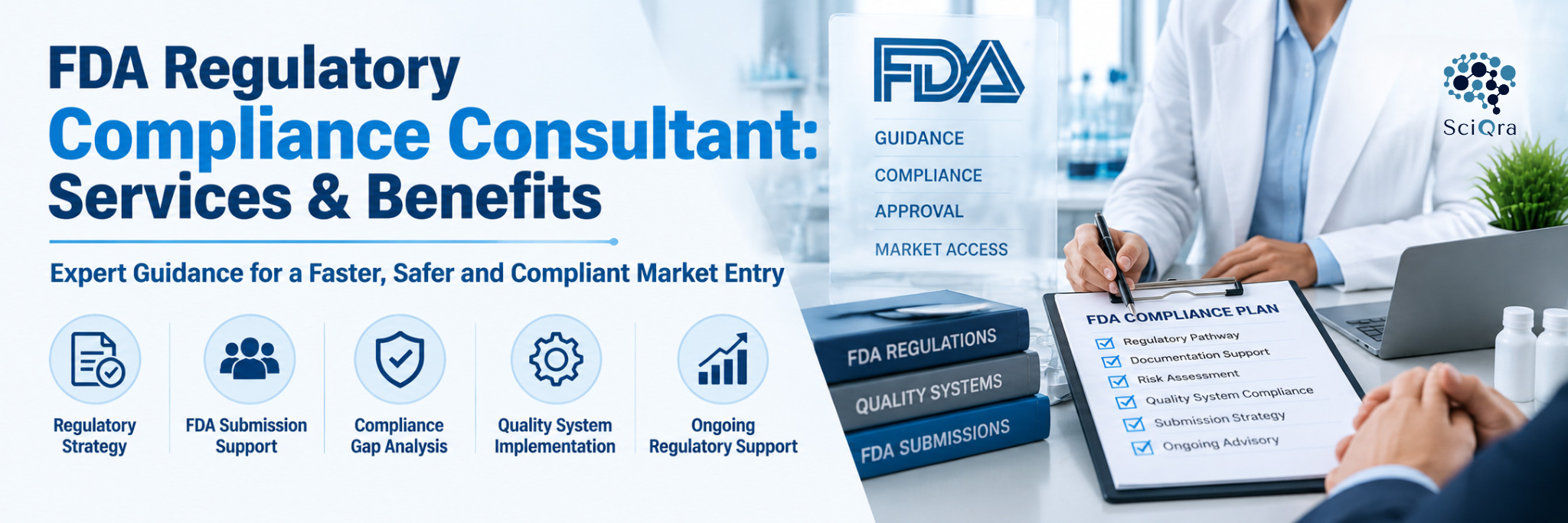
An FDA regulatory compliance consultant helps product brands understand and address the specific FDA requirements that apply to their product, based on its category, intended use, claims, and manufacturing activities. This work commonly includes product classification, regulatory pathway analysis, labeling review, documentation support, and compliance gap assessment. FDA compliance is product-specific: a cosmetic, a food, a dietary supplement, a drug, and a medical device each follow different regulatory frameworks. Brands typically hire an FDA regulatory compliance consultant before finalizing a product launch, entering the U.S. market, or making regulatory claims, since early review can identify issues before significant investment in manufacturing or packaging has already occurred.
Introduction
Most product brands don't discover a regulatory problem during development. They discover it after packaging is printed, inventory is manufactured, or a product is already sitting at a U.S. port, which is exactly the point where fixing a compliance gap becomes expensive rather than straightforward. An FDA regulatory compliance consultant exists to catch that gap earlier, when it's still cheap to fix.
The challenge many brands run into is that FDA doesn't regulate every product the same way. A cosmetic ingredient, a food additive, a dietary supplement, and a medical device each answer to different parts of FDA's regulatory framework, with different documentation expectations, different premarket pathways, and different labeling rules. Assuming one universal compliance checklist applies across categories is one of the most common and costly mistakes brands make.
This article walks through what an FDA regulatory compliance consultant actually does, why product brands bring one in, how that support typically unfolds across a product launch, and what separates this role from an in-house regulatory team, a law firm, or a testing lab. It's written for brands trying to figure out whether, and when, this kind of expertise makes sense for their specific product.
What Is an FDA Regulatory Compliance Consultant?
An FDA regulatory compliance consultant is a professional who helps companies understand and address the FDA requirements that apply to their specific product, based on its category, intended use, claims, ingredients, and manufacturing activities. The role centers on regulatory strategy, compliance review, and documentation support tailored to a particular product and market.
It's worth being precise about the boundaries of this role. A consultant advises and supports a company's regulatory decision-making; they don't replace FDA's own review and decision-making authority, and no consultant can promise a specific regulatory outcome. Their value comes from applying accumulated regulatory knowledge to a brand's specific situation, not from any special access to or influence over FDA itself.
What Does an FDA Regulatory Compliance Consultant Actually Do?
At the core, an FDA regulatory compliance consultant assesses whether and how FDA regulations apply to a specific product, then helps the brand build a compliance strategy around that assessment. This starts with regulatory applicability assessment and product classification, determining which regulatory framework governs a given product and what that means practically.
From there, the work typically extends into regulatory pathway analysis and compliance gap assessment, identifying where a brand's current documentation, labeling, or manufacturing practices fall short of what's expected. Labeling review and documentation review are common threads throughout, since these areas surface compliance issues more often than almost any other part of a product launch. Where applicable, consultants provide submission support, quality and GMP support, and coordination around safety and risk assessment work, along with structured support for communicating with FDA when appropriate. Post-market compliance support rounds out the engagement for many brands, since regulatory obligations don't end at launch. Exactly which of these services a brand needs depends heavily on its specific product category and the regulatory pathway that applies to it; not every engagement touches every one of these areas.
Why Do Product Brands Need FDA Regulatory Consulting?
FDA regulations are genuinely complex, and that complexity multiplies when a brand isn't certain how its specific product is classified in the first place. Unclear product classification is one of the most common reasons brands seek outside expertise, since the wrong classification can lead a company down an entirely inappropriate compliance path.
New product launches and U.S. market entry are natural trigger points, particularly for international brands unfamiliar with how FDA's framework differs from their home market's regulatory system. Labeling uncertainty and claims review come up constantly, since even well-intentioned marketing language can shift a product's regulatory classification without a brand realizing it. Registration or listing questions, safety documentation gaps, submission requirements, and manufacturing compliance concerns all send brands looking for outside support, as do genuine regulatory changes that outpace what an internal team has bandwidth to track. Limited internal regulatory expertise is often the underlying reason behind all of these triggers; smaller brands in particular rarely have a dedicated regulatory affairs function large enough to cover every product category they touch. Early regulatory review helps identify these issues before a brand has sunk significant investment into manufacturing, packaging, or broader commercialization, though it's worth being direct: no consultant can guarantee FDA approval or guarantee that a product will clear every regulatory hurdle.
What FDA Compliance Services Can a Consultant Provide?
Regulatory assessment and product classification typically come first, establishing the foundation everything else builds on. Regulatory strategy follows naturally from that classification work, mapping out what compliance actually requires for the specific product involved. Where applicable to the product category, registration and listing support helps brands navigate the specific submission or notification process their product falls under.
Labeling compliance review is one of the most consistently requested services, given how often labeling issues create downstream problems. Regulatory documentation support helps brands organize and maintain the records a given pathway expects, while submission support, where a premarket submission applies, helps prepare that material for FDA review. Safety and risk assessment coordination connects the regulatory strategy to the underlying scientific evidence supporting a product's safety, and GMP or quality compliance support addresses manufacturing-side obligations relevant to the product category. Post-market compliance rounds out the picture, covering ongoing obligations like adverse event handling or labeling updates that persist well after a product has launched. The applicability of each of these services depends entirely on the product category in question; a cosmetic brand and a medical device company will draw on a meaningfully different subset of this list.
How FDA Consultants Help With New Product Launches
Regulatory involvement works best when it starts at the concept stage, determining whether a proposed product and its intended claims fall under FDA oversight at all, and if so, which requirements apply. Product classification follows, assessing the specific regulatory category and pathway a product falls into based on how it's positioned and intended to be used.
Formulation or design review comes next, identifying potential regulatory concerns tied to ingredients, components, or intended function before those choices are locked in. Claims review deserves particular attention here, since proposed marketing or labeling claims can shift a product's regulatory classification and obligations in ways that aren't always obvious to a marketing team working independently of regulatory input.
Safety and compliance documentation gets identified and organized in parallel, establishing what evidence is required or appropriate to support the product's safety and intended use. Label review evaluates the applicable labeling requirements for the specific category involved, and where relevant, registration, listing, or submission processes get supported directly. A pre-launch compliance review serves as a final check, identifying any unresolved gaps before commercialization moves forward. Post-launch support then addresses whatever ongoing obligations apply, including reporting, recordkeeping, product changes, complaint handling, or other regulatory requirements tied to the product category.
FDA Regulatory Compliance Consultant vs. In-House Regulatory Affairs Team
Understanding how a consultant's role differs from other regulatory and quality resources helps brands figure out what kind of support actually fits their situation.
These roles overlap more than the table might suggest, and the right combination depends heavily on the company and product involved. A larger organization might maintain an in-house regulatory team while still bringing in outside consulting support for a specific product launch or a category the internal team hasn't handled before, while a startup might rely entirely on outside consulting until it reaches a scale that justifies building internal regulatory capacity.
FDA Regulatory Requirements Depend on the Product Category
This is one of the most important things to understand about FDA compliance: requirements differ substantially across product categories, and treating them as interchangeable is a reliable source of costly mistakes. Cosmetics follow a different regulatory framework than foods, which differ again from dietary supplements, drugs, medical devices, and biologics, each governed by its own set of statutory and regulatory requirements.
These differences show up across nearly every compliance dimension: registration and listing obligations vary by category, as do premarket submission requirements, expectations around clinical evidence, manufacturing and GMP standards, labeling rules, what claims are permissible, adverse event reporting obligations, and ongoing post-market responsibilities. A drug generally requires a fundamentally different premarket pathway than a cosmetic, and a medical device follows yet another framework distinct from both. There is no single universal checklist that correctly applies across all of these categories; the specific requirements for any given product depend on how it's classified and regulated under the applicable FDA framework.
What Does an FDA Compliance Consultant Review Before a Product Launch?
A thorough pre-launch review typically starts with the product category itself and its intended use, since these two factors drive most of what follows. Product claims get scrutinized closely, alongside the ingredients or components that make up the formulation or design.
Manufacturing process details and facility information come under review where relevant to the applicable regulatory pathway, along with labeling, packaging, and any existing safety data or technical documentation already on file. Risk information, regulatory history relevant to the product or similar products, the intended distribution model, and import considerations for products manufactured outside the U.S. round out a comprehensive review. What actually gets examined, and how deeply, depends entirely on the applicable FDA regulatory framework for that specific product category.
FDA Labeling Compliance Support
Labeling draws more regulatory scrutiny than almost any other element of a product launch, largely because it's the most visible, consumer-facing expression of a brand's regulatory claims and obligations. Common areas of review include product identity, required regulatory statements, ingredient declarations where applicable to the category, and net quantity information.
Manufacturer or distributor information, warning statements where relevant, directions for use, and the product's overall claims all factor into a thorough labeling review, along with contact information where a specific category requires it. It's important not to treat labeling as a one-size-fits-all exercise: a food label, a cosmetic label, a dietary supplement label, and a medical device label each follow different category-specific rules, and applying one category's labeling logic to another's product is a common and avoidable error.
FDA Registration, Listing, and Approval: What Is the Difference?
These three terms get used interchangeably in casual conversation, but they mean distinctly different things, and conflating them creates real regulatory risk.
Registration generally refers to establishment or facility registration, where a company registers a manufacturing or processing site with FDA, applicable to certain product categories. Listing generally refers to product-specific listing requirements that apply to certain FDA-regulated categories, providing FDA with information about a specific product rather than the facility that makes it. Premarket approval, clearance, or authorization refers to a formal FDA review and decision process that applies to specific product categories and pathways, not universally across every FDA-regulated product.
It's worth stating this plainly: "FDA approval" is not a generic status that applies to every product FDA regulates. Many FDA-regulated products, including most cosmetics, do not go through a formal premarket approval process at all, while other categories, like certain drugs, generally do. Registration or listing, where applicable, does not mean FDA has approved a product; these are distinct regulatory concepts that shouldn't be used interchangeably in marketing or compliance communications.
How an FDA Regulatory Consultant Supports Compliance Documentation
Documentation support typically covers regulatory assessments explaining a product's classification and applicable requirements, alongside organized product information, ingredient or component documentation, and relevant safety information tied to the underlying toxicological assessment work supporting the product's safety basis.
Labeling documentation, manufacturing information, and quality records all need to stay current and traceable, since documentation that was accurate at launch can become outdated as formulations, suppliers, or claims evolve. Regulatory correspondence, submission materials where applicable, and supporting evidence for safety or efficacy claims round out a well-organized compliance file. The underlying principle across all of this is consistency: documentation should be organized, current, traceable to its source, and appropriate to the specific regulatory pathway the product follows, not just accurate at a single point in time.
FDA Compliance Checklist for Product Brands
Identify the product category
Determine whether FDA regulates the product
Review intended use and claims
Identify applicable FDA requirements for that category
Determine whether registration or listing applies
Review safety and technical documentation
Review labeling against category-specific requirements
Evaluate manufacturing and quality requirements
Determine whether a premarket submission is required
Establish applicable post-market procedures
Document compliance decisions and their rationale
Monitor regulatory changes relevant to the product category
Common FDA Compliance Mistakes Product Brands Make
Waiting until after product development is complete to consider FDA requirements is one of the costliest mistakes, since formulation, packaging, and claims decisions are far cheaper to adjust early than after manufacturing has begun. Assuming all products require FDA approval, when many categories don't follow a formal premarket approval process at all, leads brands to either over-invest in unnecessary submissions or, in some cases, misunderstand what genuine compliance actually requires.
Confusing registration with approval, and ignoring how product claims can shift regulatory classification, both create exposure that's entirely avoidable with earlier review. Using incorrect labeling, often by borrowing a format from a different product category, and assuming that compliance with another country's regulations automatically satisfies FDA requirements, are persistent and costly misconceptions.
Failing to maintain organized documentation, underestimating manufacturing and quality requirements, and ignoring post-market obligations after launch all compound over time. Relying on outdated FDA guidance, assuming one compliance pathway works identically for every product, and treating regulatory review as a one-time task rather than an ongoing practice round out the most common and avoidable mistakes brands make.
When Should You Hire an FDA Regulatory Compliance Consultant?
The earlier the better, ideally before product development is finalized and certainly before any regulatory claims are locked into packaging or marketing materials. Bringing in support before packaging or labels go to print, and before entering the U.S. market for the first time, gives a brand genuine flexibility to adjust course if a concern surfaces.
Other clear triggers include approaching registration or listing where applicable, preparing regulatory documentation for submission, changing a product's formulation or design, or revising claims after launch. Receiving regulatory questions directly from FDA, discovering compliance gaps internally, or recognizing that internal regulatory expertise simply doesn't cover a specific product category are all strong signals that outside support is worth the investment. Earlier regulatory involvement consistently helps identify potential issues while they're still inexpensive to correct, rather than after they've become embedded in manufacturing or marketing decisions.
What Are the Benefits of Hiring an FDA Regulatory Compliance Consultant?
Better regulatory planning is the most immediate benefit, giving a brand a product-specific compliance strategy rather than a generic approach borrowed from an unrelated category. Early identification of gaps prevents costly late-stage surprises, and more organized documentation strengthens a brand's position if that documentation is ever reviewed or questioned.
A clearer understanding of applicable FDA requirements, meaningful labeling support, and guidance through the correct regulatory pathway all reduce uncertainty during product development. For brands facing a premarket submission, efficient preparation genuinely speeds up that process, and cross-functional coordination between regulatory, marketing, and manufacturing teams tends to improve when a consultant is actively bridging those conversations. For international brands, this kind of support often makes U.S. market entry considerably more manageable. None of this comes with a guarantee of approval or guaranteed compliance; what it offers is a more informed, better-prepared path through a genuinely complex regulatory landscape.
How to Choose the Best FDA Regulatory Compliance Consultant
Product-category expertise matters more than general regulatory experience, since FDA requirements diverge so significantly across categories that broad familiarity doesn't always translate into category-specific competence. Relevant FDA experience, genuine regulatory affairs knowledge, and solid scientific understanding all separate a strong consultant from one who's simply well-versed in paperwork.
Labeling expertise and, where relevant, submission experience for the specific pathway involved are worth confirming directly, as is quality and GMP knowledge if manufacturing compliance is part of the engagement. Communication quality and documentation standards reveal a lot about how a consultant actually works day to day, and transparency about the scope and limitations of their support, including being upfront about what they can't guarantee, is a genuinely good sign. Experience with both U.S. and international brands matters for companies entering the U.S. market for the first time, and the ability to explain regulatory requirements clearly, rather than in dense regulatory jargon, makes the entire engagement more useful.
Why Choose SciQra for FDA Regulatory Compliance Support?
SciQra supports product brands with FDA regulatory consulting across product safety assessment, regulatory compliance review, and toxicological assessment tailored to the specific product category involved. Our approach connects regulatory strategy to the underlying science, whether that's supporting a medical device compliance review or a broader product documentation and labeling assessment.
We help brands work through compliance gap assessment, product documentation, and regulatory strategy relevant to their specific formulation and target market, drawing on the same rigor behind our broader toxicology consulting services. SciQra positions itself as a scientific and regulatory support partner, not a guarantee of FDA approval, registration outcomes, or compliance status. If your brand needs support reviewing its FDA compliance position before a product launch, contact SciQra to discuss your product and timeline.
Key Takeaways
An FDA regulatory compliance consultant helps brands understand and address the specific requirements that apply to their product category, not a universal FDA process.
FDA requirements differ substantially across cosmetics, foods, dietary supplements, drugs, medical devices, and biologics.
Registration, listing, and premarket approval are distinct regulatory concepts that shouldn't be used interchangeably.
Product claims can shift a product's regulatory classification and obligations, making claims review an essential early step.
Labeling is one of the most common sources of FDA compliance issues, and requirements vary meaningfully by product category.
Organized, traceable documentation strengthens a brand's compliance position across every stage of a product's lifecycle.
Early regulatory involvement, before development is finalized, helps identify issues while they're still inexpensive to fix.
Manufacturing and GMP considerations vary by product category and shouldn't be assumed identical across categories.
Post-market obligations continue after launch and shouldn't be treated as a one-time compliance task.
No consultant can guarantee FDA approval, clearance, or authorization; professional support improves preparation, not outcomes.
Conclusion
An FDA regulatory compliance consultant helps product brands translate a genuinely complex, category-specific regulatory landscape into a clear, actionable compliance strategy. Because FDA requirements differ so significantly between cosmetics, foods, dietary supplements, drugs, medical devices, and other regulated categories, a one-size-fits-all approach rarely holds up under real scrutiny.
Early regulatory planning, careful attention to labeling and claims, and organized documentation all matter more than most brands expect until a gap surfaces at an inconvenient moment. Understanding the applicable regulatory pathway for your specific product, rather than assuming a generic process applies, is the foundation everything else builds on. If your brand is preparing a product launch or reassessing its FDA compliance position, SciQra's team can help you work through the requirements relevant to your specific product and market.
Frequently Asked Questions
What does an FDA regulatory compliance consultant do?
An FDA regulatory compliance consultant helps companies understand and address the FDA requirements specific to their product, based on its category, intended use, claims, and manufacturing activities. This typically includes product classification, regulatory pathway analysis, labeling review, documentation support, and compliance gap assessment. The specific services depend heavily on the product category, since FDA regulates different product types under different frameworks.
Why should a product brand hire an FDA compliance consultant?
Brands often hire a consultant because FDA regulations are complex and product-specific, and internal teams don't always have the specialized regulatory expertise needed for a given category. A consultant helps identify compliance issues early, before significant investment in manufacturing or packaging, reducing the risk of costly late-stage corrections. This is especially valuable for new product launches, U.S. market entry, or when product claims or formulations change.
Do all products require FDA approval?
No. FDA approval is not a universal requirement across every product category FDA regulates. Certain categories, like many drugs, generally follow a formal premarket approval or clearance process, while other categories, including most cosmetics, do not follow the same pathway. What applies to a specific product depends entirely on its regulatory classification, so it's inaccurate to assume every product needs the same type of FDA review.
What is the difference between FDA registration and FDA approval?
Registration generally refers to registering a facility or establishment with FDA, applicable to certain product categories, while approval refers to a formal premarket review and decision process that applies to specific categories and pathways. Registration does not mean FDA has approved a product; these are distinct concepts, and conflating them can lead to inaccurate compliance or marketing claims.
Can an FDA consultant help with product labeling?
Yes, labeling review is one of the most common services an FDA regulatory compliance consultant provides, since labeling requirements vary significantly by product category and are a frequent source of compliance issues. This can include reviewing product identity, required statements, ingredient declarations where applicable, claims, and other category-specific labeling requirements before a product goes to market.
When should a company hire an FDA regulatory consultant?
Ideally before product development is finalized, before making regulatory claims, and before packaging or labels are printed. Other common triggers include entering the U.S. market for the first time, approaching a registration or listing requirement, changing a product's formulation or claims, or facing a compliance gap that internal resources aren't equipped to resolve. Earlier involvement generally makes issues cheaper and easier to address.
What does FDA compliance consulting include?
FDA compliance consulting can include regulatory applicability assessment, product classification, regulatory strategy, labeling review, documentation support, and compliance gap assessment. Depending on the product category, it may also include registration or listing support, submission assistance, GMP or quality compliance support, and post-market compliance guidance. Not every engagement includes every service; scope depends on the specific product and pathway.
How can brands prepare for FDA compliance before launching a product?
Brands can prepare by identifying their product's regulatory category early, reviewing intended use and claims carefully, and confirming which FDA requirements actually apply before finalizing formulation, packaging, or labeling. Organizing safety and technical documentation, evaluating manufacturing and quality requirements, and determining whether a premarket submission applies are also important early steps, ideally undertaken well before a launch date is set.