

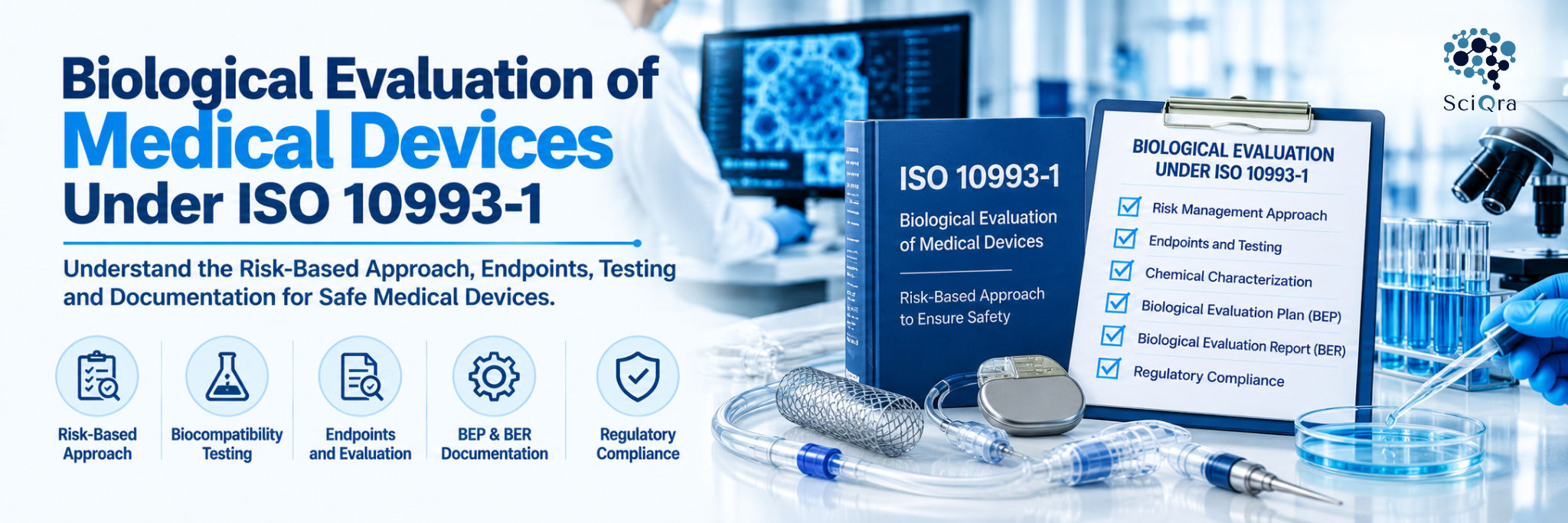
Any medical device that comes in contact with a patient, directly or indirectly, raises a safety concern before it reaches the clinic: will the materials, manufacturing residues, or degradation products pose any risk? The biological evaluation of medical devices answers that question using a structured, evidence-based process rather than a single laboratory test.
The International Organization for Standardization (ISO) 10993-1 framework is used by the medical device industry to plan the risk assessment process. It links the device's intended use, the nature and duration of contact with the body, and the materials involved to the biological risks that need to be addressed. Material selection, sterilization, and clinical use all shape the planning and outcome, and the resulting documentation becomes part of a regulatory submission. This blog walks through the evaluation work, rationale behind choosing the endpoints, and where toxicological risk assessment fits.
Quick Summary
The biological evaluation of medical devices is a risk-based process that determines whether a device's materials and use create unacceptable biological risk to patients. ISO 10993-1 provides the framework, directing manufacturers to consider intended use, type of body contact (direct or indirect), contact duration, materials, and manufacturing effects. It combines existing evidence, chemical characterization, targeted testing, and toxicological risk assessment to help interpret chemical exposure. The evaluation process is documented in the biological evaluation plan (BEP), and conclusions are documented in a Biological Evaluation Report (BER). Conformity with the standard supports regulatory submissions but does not by itself guarantee clearance, approval, or CE marking.
Quick Answer: How Is Biological Evaluation Conducted Under ISO 10993-1?
Manufacturers define the device and its intended use, identify the type and duration of body contact, and review materials and manufacturing processes. They then select relevant biological endpoints, evaluate existing scientific evidence, and perform chemical characterization or testing only where gaps are justified. Finally, they assess residual biological risk, apply toxicological risk assessment where appropriate, and document conclusions in a Biological Evaluation Report (BER) integrated with ISO 14971 risk management.
Which Edition of ISO 10993-1 Applies?
The definitive current version is ISO 10993-1:2025 (6th Edition), which was published on 18 November 2025 and officially replaced the 2018 version. Because regulatory bodies adopt updates at different speeds, manufacturers may find themselves working to the 2025 edition, the 2018 edition, or a specific version recognized by a particular authority depending on their target market geography and submission timing. Industry summaries of the 6th edition highlight a major shift away from a single Annex A matrix table toward a more explicitly risk-based approach, alongside a simplified device categorization by contact type, a more conservative way of calculating contact duration through "contact days," and explicit attention to bioaccumulation and reasonably foreseeable misuse. While the European Union (EU MDR) expects new submissions to align with this state-of-the-art 2025 version, the US FDA formally recognized the 2025 edition with specific exclusions (such as Clause 6.9) on May 25, 2026, while allowing a transition window that accepts the 2018 edition for submissions until July 1, 2029. Consequently, before finalizing any Biological Evaluation Plan (BEP), you must confirm the exact edition currently recognized by your relevant authority—such as the FDA’s recognized consensus standards database or the EU harmonized standards—and consult the official text of the standard itself rather than relying on secondary summaries.
Why Is Biological Evaluation Important for Medical Devices?
Patient safety comes first because materials that are safe in one application can behave entirely differently in another due to processing aids, sterilization residues, leachable additives, or degradation products. A hazard that never appears in a bulk material datasheet may easily emerge after the finished device is manufactured, sterilized, and placed in contact with human tissue. For this reason, biocompatibility cannot be established solely by pointing to a material that is described as "medical grade" or has been used in another product; contact site, duration, surface area, and processing history all fundamentally change patient exposure. Regulators expect manufacturers to show exactly how these factors were considered, and the evaluation also directly feeds critical product development decisions. Material changes, supplier selection, and sterilization method choices are far cheaper and easier to adjust before a design freeze than after a formal regulatory submission raises deficiency questions.
What Is ISO 10993-1 and What Does It Cover?
ISO 10993-1 describes the fundamental principles of biological evaluation within a risk management process, setting out how devices are categorized, which biological effects must be considered, and how conclusions are documented. As the primary entry point to the wider ISO 10993 series, it directs manufacturers to separate parts that address specific evaluation methods, including cytotoxicity (ISO 10993-5), sensitization and irritation (ISO 10993-10, with newer parts for some endpoints), chemical characterization (ISO 10993-18), and toxicological risk assessment (ISO 10993-17). Crucially, this biological evaluation is not a one-time event; it runs continuously across the entire device lifecycle and must be formally revisited whenever materials, suppliers, manufacturing processes, sterilization methods, or the intended use change.
ISO 10993-1 and ISO 14971
ISO 14971 governs medical device risk management, and biological evaluation sits directly inside that framework to ensure biological hazards are identified, risks are estimated and evaluated, controls are applied, and residual risk is properly documented. Treating the biological evaluation as a separate paperwork exercise is a common weakness in regulatory submissions; the risk management file and the biological evaluation documents should explicitly reference each other and maintain completely consistent hazard definitions and risk conclusions.
Does ISO 10993-1 Require Every Medical Device to Undergo Biological Testing?
No, ISO 10993-1 does not require every medical device to undergo biological testing. Instead, the standard requires that relevant biological risks be thoroughly evaluated, rather than mandating that every single endpoint be tested in a laboratory setting. Manufacturers can successfully support conclusions for some biological endpoints by leveraging existing data on the same or equivalent materials and processing, performing chemical characterization, and providing scientifically justified rationales. Additional laboratory testing only becomes appropriate where the existing evidence is insufficient to prove safety, and the specific justification for each testing or waiver decision must be clearly documented.
ISO 10993-1 Risk-Based Approach to Biological Evaluation
A risk-based approach starts from the device rather than from a test list, focusing on key questions such as what the device is used for, which tissue it contacts, how long and how often exposure occurs, what it is made of, and how it is processed and sterilized. Available biological data, identified hazards, evidence gaps, and residual risks then determine exactly what additional work is needed to ensure safety.
This approach successfully helps avoid unnecessary testing without compromising patient safety, allowing a manufacturer to justify—with robust materials information and toxicological reasoning—that an endpoint is already adequately addressed so that studies do not need to be repeated. Conversely, this approach prevents false reassurance, meaning that if the existing evidence does not support a clear safety conclusion, the data gap must be actively closed through further evaluation or testing.
Classification of Medical Devices by Contact Type and Duration
Categorization determines which biological effects deserve attention. Two characteristics matter most: what the device touches and for how long.
Types of Body Contact
Earlier editions grouped devices as surface-contacting, externally communicating, or implantable combined with a specific contact site, but industry summaries of the 2025 edition indicate a move toward categorizing directly by the type of contact itself, including intact skin, intact mucosal membranes, breached or compromised surfaces, and tissue, bone, or blood contact. Because of these structural changes, you must confirm the exact category names and classification structure in the specific edition you are applying to your submission. Regardless of the version used, the underlying practical point remains unchanged: a device in direct blood contact or one implanted deep in tissue has a vastly different exposure pathway than a device resting on intact skin, and your biological evaluation must explicitly reflect that specific level of risk.
Contact Duration
Duration categories are commonly described as limited for up to 24 hours, prolonged for more than 24 hours up to 30 days, and long-term for more than 30 days. The 2025 edition reportedly sharpens how total exposure is calculated, including cumulative use over multiple applications and the concept of contact days, and states that where bioaccumulation is a concern, a longer duration category may apply unless justified. For reusable devices or products used repeatedly, this can move a device into a longer category than a single-use view suggests. Consequently, you must verify the thresholds and calculation rules in your verified edition before assigning a final category to your device.
Biological Endpoints Considered Under ISO 10993-1
Endpoints are the biological effects the evaluation considers. Which ones apply depends on the device's contact type, duration, materials, and risk profile. Not every endpoint requires a separate physical test.
Cytotoxicity
Cytotoxicity evaluates whether device materials or extracts exert toxic effects on cell viability. As an essential primary screening endpoint, it applies to nearly all patient-contacting devices and is typically assessed using in vitro methods per ISO 10993-5.
Sensitization
Sensitization assesses whether device components—such as additives, processing aids, or residual monomers—can induce an allergic immune reaction following exposure. Evaluation methodologies for this endpoint are detailed in ISO 10993-10 and its associated standards.
Irritation
Irritation covers local tissue responses such as redness or inflammation after contact. It matters especially for skin, mucosal, and breached surface contact, and the evaluation considers extract chemistry as well as the device surface itself.
Systemic Toxicity
Systemic toxicity addresses effects away from the contact site when constituents are released and absorbed. Evidence here often comes from chemical characterization and toxicological assessment, with in vivo studies considered when data are insufficient (ISO 10993-11 provides guidance).
Genotoxicity
Genotoxicity examines whether constituents can damage genetic material. It is typically relevant for devices with prolonged or long-term exposure and is often approached through in vitro assays or toxicological screening of identified chemicals.
Implantation Effects
For implanted or tissue-contacting devices, local tissue response after implantation is evaluated, including inflammation and tissue integration over time. ISO 10993-6 describes methods for assessing local effects after implantation.
Additional Biological Endpoints
Depending on the device, further endpoints may include hemocompatibility for blood-contacting devices, material-mediated pyrogenicity, carcinogenicity, reproductive and developmental toxicity, chronic toxicity, and degradation-related effects. Consider each endpoint where the device's contact, duration, materials, and likely substance release make it relevant, and document the decision to address it through testing, existing data, or justification.
Medical Device Chemical Characterization and Toxicological Risk Assessment
Chemical characterization and toxicological risk assessment are central to modern biological evaluation because many biological risks arise from substances released by the device. Together they help identify what a patient could be exposed to and whether that exposure is acceptable.
What Is Chemical Characterization?
Chemical characterization identifies and, where appropriate, quantifies a device's constituents and what it can release. That includes material composition, extractables and leachables, manufacturing and processing residues, sterilization residues such as ethylene oxide, and degradation products. ISO 10993-18 describes the approach. Interpreting those results typically depends on toxicological risk assessment, because a list of detected chemicals only becomes meaningful once it is compared with toxicological information.
What Is Toxicological Risk Assessment?
Toxicological risk assessment under ISO 10993-17 evaluates whether the estimated patient exposure to each released chemical is acceptable. This process involves identifying the chemical, estimating exposure from the device and its clinical use, gathering hazard information, and considering dose-response relationships. Analysts use this data to derive acceptable exposure levels and characterize the overall risk, which includes calculating a clear margin of safety. An uncertainty analysis is always a core part of this process since data are rarely complete and all evaluation assumptions must remain fully transparent.
How Do Chemical Characterization and Toxicological Assessment Work Together?
Chemical data describe what could be released; toxicology describes what those substances can do at the estimated dose. Combined, they can support conclusions for several endpoints and reveal remaining evidence gaps, for example, an unidentified extractable or a compound lacking toxicity data. They do not universally replace biological testing. Whether chemistry-based evidence is sufficient depends on the device, the endpoint, and the quality and completeness of the data.
Step-by-Step Biological Evaluation Process Under ISO 10993-1
The workflow below is a practical, general sequence. Adapt it to the device and the edition you apply.
Define the medical device and its intended use. Establish what is being evaluated by documenting the device description, clinical indications, patient population, and any reasonably foreseeable misuse.
Identify patient contact type and duration. Categorize exposure by documenting the contact tissue, frequency, and total exposure period while carefully noting any cumulative or repeated use.
Review device materials and manufacturing processes.
Understand what patients may be exposed to by collecting material specifications, supplier data, additives, processing aids, and details on cleaning and sterilization.Identify relevant biological endpoints. Define the scope of the evaluation and record exactly why each specific endpoint is or is not relevant.
Review existing scientific and biological evidence. Use what is already known by critically evaluating literature, prior test data, and equivalence arguments for relevance and quality.
Identify biological data gaps. Separate what is supported from what is not by listing all endpoints that currently lack adequate evidence.
Conduct additional characterization or testing. Close justified data gaps by choosing evaluation methods that match the device and documenting the specific rationale.
Perform a toxicological risk assessment. Evaluate chemical exposure by estimating patient exposure, comparing it with acceptable limits, and documenting uncertainty.
Evaluate and document residual biological risks. Conclude the process and integrate your final findings directly with the ISO 14971 risk management file.
Prepare the Biological Evaluation Report. Summarize all evidence and conclusions in a traceable, cohesive document that regulators can easily review.
Biological Evaluation Plan (BEP) vs Biological Evaluation Report (BER)
What Is a Biological Evaluation Plan?
The Biological Evaluation Plan sets the strategy before work begins. It typically describes the device and its intended use, materials, contact categorization, and available evidence, while outlining the relevant endpoints, identified data gaps, and the proposed approach, complete with a robust scientific justification for including or excluding specific endpoints.
What Is a Biological Evaluation Report?
The Biological Evaluation Report documents the outcome. It summarizes the reviewed evidence, test results where applicable, chemical characterization, and toxicological conclusions, while detailing the biological risk assessment, remaining uncertainties, and the overall biological safety conclusion.
Biological Evaluation Requirements for Implantable Medical Devices
Implantable devices usually receive the most extensive evaluation because tissue exposure is prolonged and chemicals released can reach systemic circulation over time. Critical considerations include the local tissue response to the implant, material stability, degradation products for absorbable or corroding materials, systemic exposure to leachables, and long-term biological safety. The applicable endpoints depend heavily on the implant's design, materials, intended use, and contact profile. Strong supporting evidence typically includes detailed material characterization, relevant literature on the materials in similar applications, and a toxicological assessment of released substances, combined with targeted testing where gaps persist. Because implants are difficult to modify after release, documenting the scientific justification is particularly important.
ISO 10993-1 and Medical Device Regulatory Compliance
Biological evaluation supports regulatory documentation, but standards and regulations are not interchangeable. Manufacturers working across markets often need coordinated medical device toxicology and regulatory support so one evaluation can support multiple submissions where possible.
United States — FDA
FDA has published guidance on using ISO 10993-1 for biocompatibility evaluation in premarket submissions, and the standard appears in FDA's list of recognized consensus standards. Recognition and guidance are not the same as mandatory requirements, and the edition FDA recognizes or addresses in guidance can differ from the most recently published edition. Check the current FDA guidance and recognition database for the edition and expectations that apply to your submission type.
European Union — EU MDR
Under the EU Medical Device Regulation, biological safety evidence forms part of the broader general safety and performance requirements and the clinical and technical documentation. Harmonized standards offer a route to presume conformity with relevant requirements, but the version cited in the Official Journal determines which edition provides that presumption. Notified bodies review the rationale and evidence as a whole.
United Kingdom and Other Markets
The United Kingdom, Canada, India, and other markets each maintain their own regulatory frameworks and recognized standards, which may reference different editions or add local expectations. Confirm requirements with the relevant authority, such as the MHRA in the United Kingdom, before assuming a single evaluation will satisfy every market. Conformity with ISO 10993-1 alone does not guarantee clearance, approval, CE marking, or authorization anywhere.
Common Challenges in Medical Device Biological Evaluation
Incomplete material information is one of the most common problems, especially when suppliers refuse to disclose formulations or when additives and processing aids are overlooked. Incorrect contact categorization, such as ignoring cumulative or repeated use, can also narrow the evaluation scope. Practical remedies include early supplier engagement, confidentiality arrangements for formulation data, and a documented rationale for categorization. Other recurring problems include unjustified endpoint selection, missing chemical characterization evidence, and weak toxicological risk assessment, such as unidentified extractables with no assessment or exposure estimates that ignore realistic use. Overreliance on historical test data is another trap, as older data may not reflect current materials, processing methods, or standard editions. Inadequate documentation, poor integration with the ISO 14971 risk file, and failure to reassess biological risk after material, supplier, manufacturing, or sterilization changes complete the usual list. Maintaining a living Biological Evaluation Plan (BEP) and establishing a clear change control trigger for reassessment successfully address most of these challenges.
ISO 10993-1 Biological Evaluation Checklist for Manufacturers
Use this as a planning aid, not as a substitute for the standard or regulatory guidance.
Device intended use documented, including all indications, target patient populations, and reasonably foreseeable misuse.
Patient contact type identified, confirming the exact nature of body contact such as intact skin, mucosal membranes, breached surfaces, or tissue and blood.
Contact duration evaluated, ensuring total exposure calculations account for cumulative use, repeated applications, and contact days.
Material composition reviewed with supplier information, accounting for base polymers, colorants, hidden additives, and raw material formulations.
Manufacturing and sterilization effects considered, evaluating potential hazards from processing aids, cleaning residues, and sterilization agents.
Relevant biological endpoints identified and justified, establishing a clear, documented rationale for why each endpoint is or is not applicable.
Existing scientific evidence evaluated for relevance and quality, critically reviewing historical clinical data, literature, and material equivalence arguments.
Data gaps documented, explicitly identifying which biological endpoints currently lack sufficient supporting safety evidence.
Chemical characterization considered, leveraging ISO 10993-18 methodologies as the default first step to understand potential leachables and extractables.
Toxicological risk assessment completed where applicable, establishing clear margins of safety and documenting uncertainty for released substances under ISO 10993-17.
Additional testing scientifically justified, ensuring any required laboratory or in vitro studies are purposefully selected to close documented gaps.
Biological Evaluation Plan prepared, capturing the proactive strategy, testing rationales, and risk methodologies before execution begins.
Biological Evaluation Report documented, synthesizing all test results, toxicological conclusions, and final evidence into a traceable summary.
Residual risks evaluated and linked to the risk management file, ensuring absolute consistency in hazard definitions and risk scoring with ISO 14971.
Applicable regulatory expectations and standard editions reviewed, confirming the active version recognized by your specific target authorities before submission.
When Should Manufacturers Consult a Medical Device Biocompatibility Expert?
Specialist input is most valuable when judgment and toxicological interpretation drive the outcome. Typical examples include new device development, implantable devices, complex material combinations, and insufficient biological data. Other common triggers include difficult-to-interpret chemical characterization results, material, manufacturing, or sterilization changes, and the preparation of a regulatory submission or Biological Evaluation Report. Where existing information has holes, a structured toxicology data gap analysis can show which endpoints are already supported and which are not, helping avoid unnecessary studies.
How SciQra Supports Medical Device Biological Evaluation
SciQra provides toxicology and regulatory support for medical device manufacturers, including work described in its guidance on toxicological risk assessment of medical devices in accordance with ISO 10993. Support can include biological evaluation strategy, Biological Evaluation Plan development, Biological Evaluation Report preparation, and medical device toxicological risk assessment.
Related work includes interpreting chemical characterization data, assessing biological endpoints, evaluating scientific literature, preparing biological safety documentation, and identifying regulatory evidence gaps, all within SciQra's broader toxicology consulting services. SciQra acts as a scientific and regulatory support partner; it does not guarantee regulatory outcomes. Need expert support with biological evaluation, biocompatibility assessment, or medical device toxicological risk assessment? Contact SciQra to discuss your device's biological safety evaluation requirements.
Key Takeaways
Biological evaluation is an evidence-based risk assessment of patient-contacting devices, not merely a set of laboratory tests.
ISO 10993-1 provides the framework and sits within ISO 14971 risk management.
Confirm which edition applies; ISO 10993-1:2025 replaced the 2018 edition, but regulators recognize editions on their own timelines.
A risk-based approach starts with intended use, contact, materials, and processing, and avoids unnecessary testing.
Contact type and duration, including cumulative use, drive which biological effects must be considered.
Endpoint selection must be justified; not every endpoint requires a separate physical test.
Chemical characterization identifies what a device can release, including extractables, leachables, and residues.
Toxicological risk assessment interprets that exposure, but its sufficiency depends on the device and the data.
The BEP sets the strategy and the BER documents evidence, residual risk, and conclusions.
ISO 10993-1 conformity supports regulatory submissions but does not guarantee clearance, approval, or CE marking.
Conclusion
The biological evaluation of medical devices under ISO 10993-1 is a risk-based process that connects intended use, patient contact, materials, and manufacturing directly to the biological effects that need attention. Chemical characterization and toxicological risk assessment fundamentally strengthen that process by showing exactly what patients may be exposed to and whether that exposure is acceptable, while physical testing fills only the gaps that existing evidence cannot close. A Biological Evaluation Plan (BEP) sets the strategic direction, and a Biological Evaluation Report (BER) documents the final justification; manufacturers must keep both current as devices change over time. Because standard editions and regulatory recognition differ across global markets, always verify what applies to your specific submission before finalizing your files. If you would like a second set of eyes on your strategy, SciQra's team is available to discuss your device and evidence needs.
Frequently Asked Questions
What is the biological evaluation of medical devices under ISO 10993-1?
It is a structured, risk-based assessment of whether a device's materials and use create unacceptable biological risk. ISO 10993-1 guides manufacturers to consider intended use, body contact, duration, and materials, then combine existing evidence, chemical characterization, and targeted testing into a documented conclusion within an ISO 14971 risk management process.
Why is ISO 10993-1 important for medical device manufacturers?
It gives a recognized framework for demonstrating biological safety and organizing evidence for regulators. It links device characteristics to biological risks, helps justify which endpoints matter, and supports consistent documentation. Following it does not guarantee approval, but it makes the safety rationale easier for reviewers to follow.
Is biocompatibility testing mandatory for every medical device?
No. ISO 10993-1 requires that relevant biological risks be evaluated, not that every endpoint be tested. Existing data, material characterization, and justified rationales can address some endpoints. Testing becomes appropriate when evidence is insufficient. Regulators may also have expectations for particular device types, so confirm requirements for your submission.
How is the biological evaluation of medical devices conducted?
Manufacturers define the device and intended use, identify contact type and duration, review materials and processing, select relevant endpoints, and evaluate existing evidence. They then identify gaps, add characterization or testing where justified, assess toxicological risk, and document residual risk in a Biological Evaluation Report.
What is the difference between biological evaluation and biocompatibility testing?
Biological evaluation is the overall risk-based assessment, while biocompatibility testing is one tool that generates data within it. An evaluation can draw on literature, chemical characterization, toxicological assessment, and prior data. Testing is added only where those sources cannot adequately support a conclusion for a given endpoint.
How does contact duration affect biological evaluation?
Longer or repeated contact generally requires consideration of more endpoints, such as systemic toxicity, genotoxicity, or implantation effects. Duration is commonly described as limited, prolonged, or long-term, and recent revisions emphasize cumulative exposure. Check the thresholds and calculation rules in the edition you apply.
What role does toxicological risk assessment play in ISO 10993-1?
It evaluates whether patient exposure to chemicals released from a device is acceptable. Using chemical characterization data, toxicological hazard information, exposure estimates, and acceptable exposure levels, it characterizes risk and uncertainty. It can support several endpoints, though sufficiency depends on the device and data quality (see ISO 10993-17).
What is the difference between a Biological Evaluation Plan and a Biological Evaluation Report?
The plan sets out strategy before work begins: device description, contact categorization, endpoints, data gaps, and justified activities. The report documents the outcome: evidence reviewed, results, toxicological conclusions, residual risks, and the overall safety conclusion. The plan guides the work; the report demonstrates it.
What biological evaluation considerations apply to implantable medical devices?
Because implants involve prolonged tissue contact, evaluation typically addresses local tissue response, material stability, degradation products, systemic exposure to leachables, and long-term safety. Endpoint selection depends on the implant's design, materials, and contact profile, with strong material characterization and toxicological assessment supporting the rationale.
Does ISO 10993-1 compliance guarantee medical device regulatory approval?
No. Conformity supports regulatory documentation but does not establish complete compliance or guarantee clearance, approval, or CE marking. Regulators assess the whole submission, including clinical, quality, and risk management evidence. Standards, guidance, and regulations are also not interchangeable, and recognized editions vary by jurisdiction.